The Sonic Sanctuary: How to Design for Sound and Verticality in 2026
Beyond Visuals: The Rise of “Acoustic Zoning”
For the last decade, urban garden design focused almost exclusively on visual privacy—screening the neighbors, hiding the dumpster, framing the sunset. I’ve seen a hundred rooftop mockups that look stunning but sound like a runway.
Silence has become the ultimate luxury asset. As urban density increases, the primary stressor is no longer what we see (which we can mitigate through Seijaku, or visual noise reduction), but what we hear. The relentless hum of the city—traffic drones, HVAC units, distant sirens—demands a different approach: Acoustic Zoning (or simply, sound buffering).
This isn’t about walling yourself in. You can’t out-build a garbage truck’s decibels. It’s about soundscaping. Progressive acoustic designers treat sound frequencies like physical objects. Some must be blocked by mass, while others must be diffused by texture (rough leaves) or masked by a competing, pleasant frequency (water).
In the high-density micro-sanctuary, we don’t have the space to plant a 50-foot buffer of trees. Instead, we have to engineer a bubble of silence using vertical mass and resonance.
Related: How to Design a Zen Garden Micro-Sanctuary
The Traditional Solution: Suikinkutsu
To achieve this masking without resorting to industrial white noise makers or loud, splashing fountains (which just add a different kind of stress), I look to the Suikinkutsu Water Harp. This traditional Edo-period device isn’t just an aesthetic feature; it’s practically the original high-fidelity soundscape tool. Research on the restorative effects of nature sounds confirms that complex, organic water rhythms significantly aid stress recovery 1.
How It Works
The Suikinkutsu involves burying a large inverted ceramic pot with a hole in the bottom. Water drips through the hole into a pool below, creating a bell-like resonance that echoes up through a bamboo tube. It produces a “plink-plonk” sound that is random, organic, and incredibly soothing.
In a modern garden, this low-frequency resonance cuts through high-frequency traffic whine more effectively than a crashing waterfall. It tricks the brain into focusing on the near-field sound rather than the far-field noise 2.
DIY Construction Details for 2026
Building a Suikinkutsu requires precision. If you’re building one this weekend, follow these specs:
- The Chamber: Use a strictly non-porous ceramic jar (fired clay) or a dense PVC chamber, at least 24 inches deep. The harder the material, the crispier the echo.
- The Drainage Layer: The jar is buried upside down on a bed of river stones. Inside the jar, the water must pool to exactly 3 inches deep before overflowing. This depth is critical for the “drop tone.”
- The Dripper: A modern irrigation dripper hidden in the gravel above feeds the hole. Calibrate it to roughly 1 drop every 1.5 seconds. Faster drips kill the echo; slower drips lose the rhythm.
- The Amplifier: A bamboo or PVC pipe connects the air cavity of the jar to the surface. Place a flat slate rock over the opening of the pipe to deflect the sound horizontally across your seating area.

The Limits of Water Masking
While the Suikinkutsu excels at near-field distraction, it is an acoustic diffuser, not a barrier. When the city throws a low-frequency rumble at you—like a diesel engine or heavy construction—plinking water won’t save you. You need mass.
The Vertical Shield: Hydroponic Zen Rock Walls
To block sound effectively, you need mass. Physics dictates that light materials (like wood fences or trellises) vibrate and transmit sound. Heavy materials (stone, earth) reflect and absorb it. But in a 4x4 city balcony, you don’t have space for a thick earth berm or a stone fortress.
The practical fix is the Hydroponic Zen Rock Wall.
Unlike the “Green Walls” of the early 2020s—which were usually just pockets of potting soil that dried out and died on you—the 2026 approach uses porous lava rock as the actual structural medium. This creates a dense, acoustic-absorbing barrier that dampens street noise significantly better than standard fencing.
Construction & Tech Specs
- Structure: A rigid frame of galvanized steel or rot-proof composite is bolted to the substrate walls. It must support substantial wet weight (up to 4 pounds per square foot).
- The Medium: High-density blocks of bonded volcanic rock and felt. They mimic the hydrology of a natural cliff face.
- The System: A silent, recirculating pump moves nutrient water from a hidden reservoir to a drip line at the top. The water trickles through the rock, not just over it.
- Acoustic Benefit: The constant moisture in the porous rock drastically increases the sound absorption coefficient. Wet, porous rock captures sound waves in its internal cavities, turning sound energy into trace heat rather than reflecting it back at your desk.
Planting The Vertical Rockery
You cannot plant marigolds in a rock wall. You must use lithophytic plants—species that have evolved to climb cliffs and rocks.
- Bird’s Nest Fern (Asplenium nidus): Excellent for catching sound with its wide, leathery fronds.
- Rock Orchid (Dendrobium): Adds sculptural beauty without needing soil.
- Creeping Fig (Ficus pumila): The visual mortar that binds the wall together.
- Mosses (Bryophyta): The ultimate acoustic dampener. A healthy moss layer drastically reduces ambient noise reflection.
The Mental Threshold: Modern Moon Gate Construction
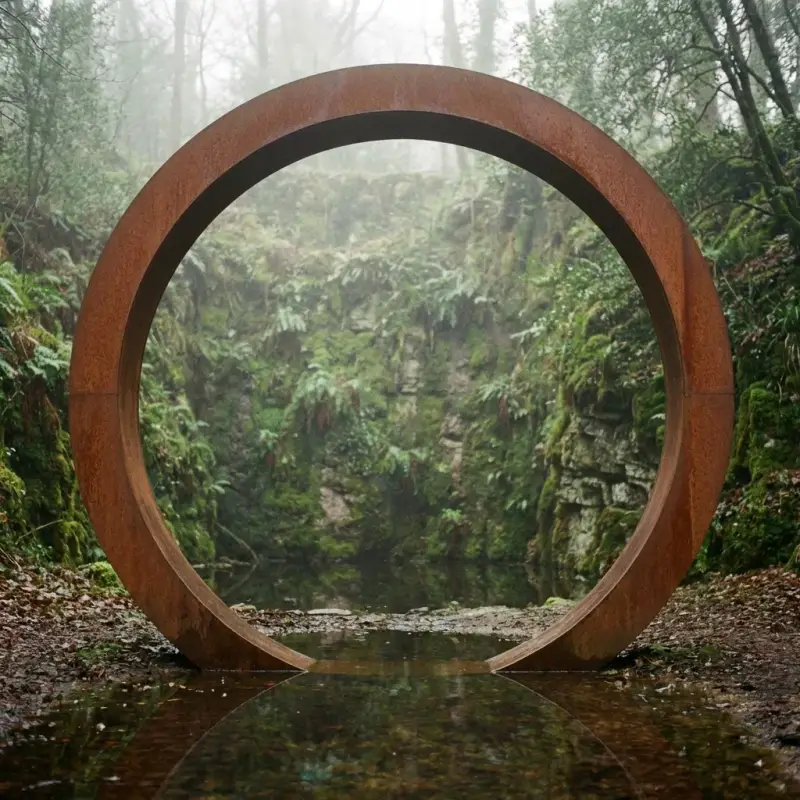
Every sanctuary needs a distinct entry point. If you walk straight from the concrete sidewalk onto your deck, your brain hasn’t registered the shift. In 2026, the Modern Moon Gate has returned as the preferred psychological airlock.
Entering through a circular frame (Ensō) triggers a subconscious shift. You are physically forced to step through a threshold, marking the transition from chaotic “street time” to slow “garden time.”
Material Shift: Steel & Char
Modern implementations favor industrial-organic materials: corten steel or charred cedar.
Corten Steel Construction: The oxidized orange rust provides a stunning complementary color contrast to deep green walls. Prefabricated steel rings are welded to a hidden base plate bolted into a concrete footer. Zero maintenance—the rust is the protective layer.
Charred Wood (Shou Sugi Ban): Offers a deep, alligator-skin texture that is black as night. Cedar boards are burned with a torch until the surface carbonizes, rendering the wood waterproof, rot-proof, and insect-proof without chemicals. (And honestly, hitting wood with a blowtorch is a deeply satisfying weekend project.)

The Destination: The Immersive Tea House
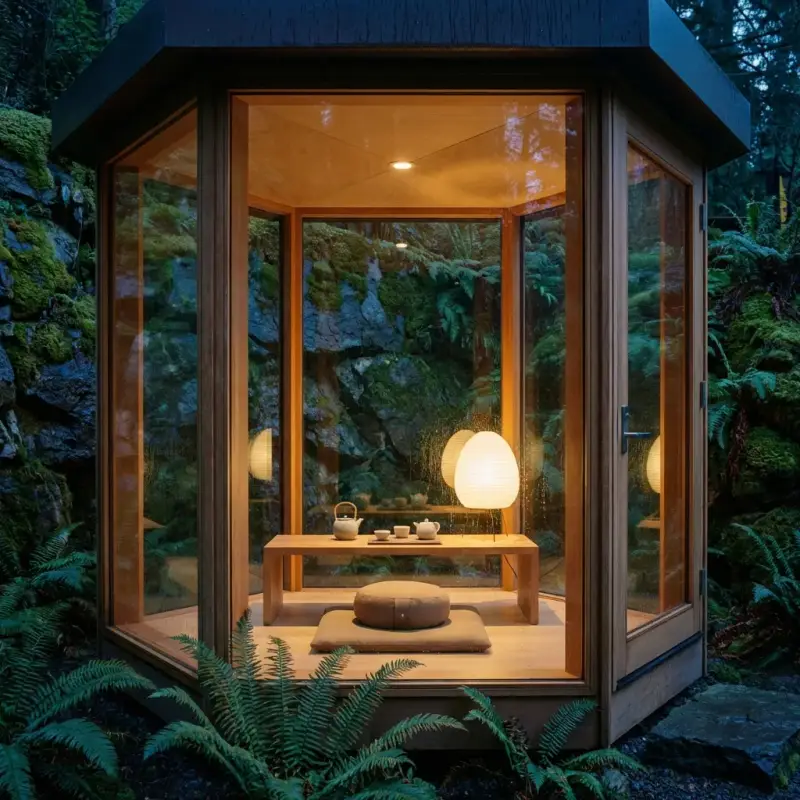
At the heart of this acoustic setup lies the ultimate retreat: the Immersive Tea House.
It’s evolved from a ceremonial artifact into a dedicated “Work-from-Garden” sanctuary. Think of it as a sensory deprivation chamber designed to shield you from city chaos.
- Sound Isolation: Double-glazed acoustic glass ensures that even if a siren wails outside, inside is silence.
- Thermal Comfort: Integrated climate control allows for year-round use—a warm cocoon in freezing Januaries and a cool refuge in July.
- Circadian Lighting: Interior lighting mimics the color temperature of the sun. Cool, blue-enriched light (4000K) for morning focus, transitioning to warm, amber light (2700K) for evening decompression.
- Digital Detox: The phone stays at the door.
A Day in the Sanctuary
07:00 AM: You enter with tea. The space is warm. The silence is absolute. You begin your day in a state of suspended calm.
01:00 PM: Meditation. Light softens to amber. The only sound is the faint, rhythmic pulse of the Suikinkutsu outside.
08:00 PM: Decompression. No devices. Just the view of the lit Moon Gate and the feeling of the wind being buffered by the hydroponic wall.
Material Science: Stone vs. Moss Acoustics
When designing your sonic sanctuary, your ground cover is the final acoustic variable.
| Material | Acoustic Property | Best Application |
|---|---|---|
| Crushed Granite | Diffuser. Scatters sound waves in random directions due to angular shape. | Use on pathways to create the “crunch” of footsteps (auditory feedback), avoiding the artificial feel of cheap colored sands (Shizen principle). |
| Polished River Stone | Reflector. Hard, smooth surfaces bounce sound. | Use primarily in the water basin to amplify the drip sound. |
| Live Moss Carpet | Absorber. The complex, sponge-like structure traps high frequencies. | Use on every vertical and horizontal surface possible for maximum silence. |
| Wood Decking | Resonator. Hollow space beneath can drum. | Fill the void beneath decking with rock wool or gravel to deaden the “drum” effect. |
This is why throwing down cheap decking and calling it a day doesn’t work. You have to account for how materials interact with sound waves. The smartest spaces use a calculated mix of all four.
The Final Cut: Engineering Silence
Visual privacy is cheap; auditory privacy requires intent. By combining the low-frequency resonance of a Suikinkutsu, the acoustic mass of a hydroponic rockery, and the stark isolation of an immersive pod, you aren’t just decorating a space. You are weaponizing design to reclaim your peace. Don’t hide from the city’s noise—engineer it out of existence.