The Art of Wabi-Sabi: Why Your Pocket Garden Needs to Be Imperfect

The Revolt Against “Curated” Nature
Scroll through any modern design feed, and you will see the same aesthetic: pristine white planters, glossy monstera leaves without a single brown spot, and succulents arranged in geometrically perfect rows. This is “Plastic Nature”—a sterilized version of the outdoors that demands constant, stressful maintenance to uphold an illusion of stasis.
But nature is not static. It is a chaotic, decaying, regenerating cycle.
By trying to freeze our gardens in a state of eternal youth, we deny them their soul. This is where Wabi-Sabi Garden Design intervenes. Originating from tea ceremony aesthetics in 15th-century Japan, Wabi-Sabi invites us to step off the hedonic treadmill of perfectionism and find peace in the reality of things as they are.
| The “Plastic” Trap | The Zen Solution |
|---|---|
| Pristine white planters | Weathered terracotta and stained concrete |
| Hiding the crack | Kintsugi: Accentuate the break |
| Static repetition | Mono no aware (The pathos of things) |
For the Zen gardener, this shift is liberating. It legitimized the use of weathered materials and “messy” elements like moss and dried ferns, which are paradoxically easier to maintain than their manicured counterparts because they are allowed to age.
Warning: Don’t you dare try to “clean” a weathered stone. That algae is the visual evidence of time’s dignity.
The Three Marks of Existence (Sanboin) in a Tray
To understand Wabi-Sabi, one must first grasp the Buddhist “Three Marks of Existence” (Sanboin). These aren’t just abstract concepts; they are design principles that can be physically represented in a potting tray.
1. Anicca (Impermanence)
Nothing lasts. The cherry blossom falls; the granite erodes.
- In the Garden: Instead of removing fading flowers immediately, a Wabi-Sabi gardener might leave a dried hydrangea head on the stem through winter. Its skeletal structure captures the frost and tells the story of the season passed. We design with materials that age visibly—untreated cedar that grays, copper that patinas, and stone that gathers moss.
2. Dukkha (Suffering/Unsatisfactoriness)
The struggle of life.
- In the Garden: This is represented by the “gnarled” aesthetic. A bonsai tree is twisted and wired not to torture it, but to mimic the struggle of a tree growing on a windy cliff. We choose plants that look like they have survived a storm, not ones that look like they just left a greenhouse. We value the “scar” on the bark.
3. Anatta (Non-Self/Emptiness)
Nothing has inherent, separate existence; everything is connected.
- In the Garden: This is the negative space (Ma). It is the empty sand between the rocks. It is the understanding that the garden is not a collection of objects, but a relationship between them. A single rock in a tray is just a rock; a rock placed off-center in a bed of raked sand becomes a mountain in a void.
The 7 Zen Principles of Wabi-Sabi Design
When laying out your micro-sanctuary, move beyond “symmetry” and “color matching.” Instead, verify your design against these seven ancient aesthetic principles.
1. Fukinsei (Asymmetry)
Nature is rarely symmetrical. Symmetry is a human imposition of control. Never place your focal point in the dead center. Use the Scalene Triangle layout.
2. Kanso (Simplicity)
Eliminate the non-essential. If an ornament doesn’t contribute to the “mood,” remove it.
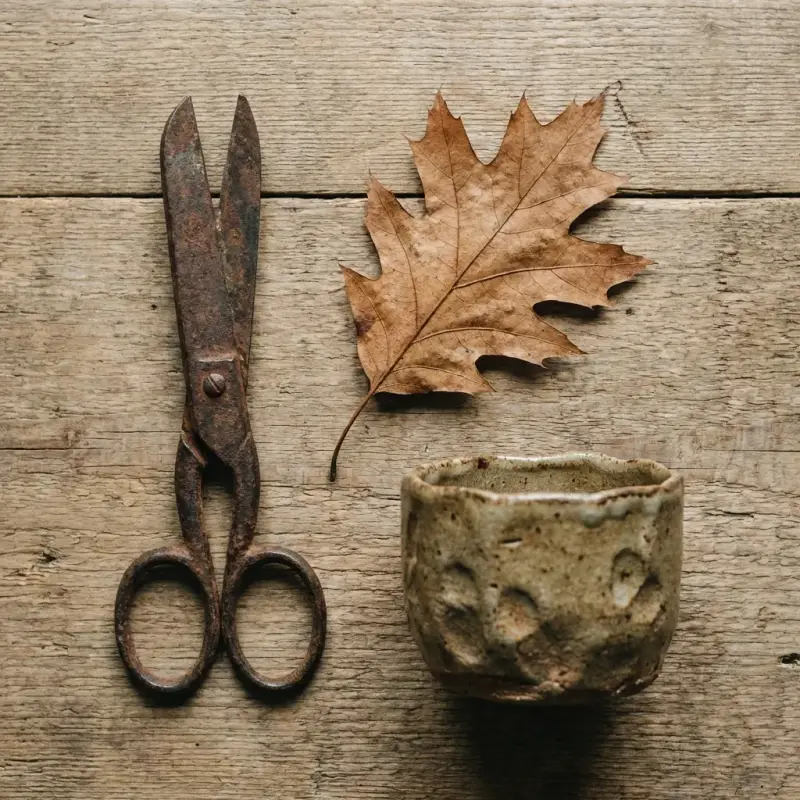
3. Koko (Weathered Antiquity)
The dignity of age. Choose uglazed terracotta or rusted Corten steel.
4. Shizen (Naturalness)
Absence of pretense. Your garden should look like a scooped-up piece of the forest floor, not a store display.
5. Yūgen (Subtle Grace)
Suggestion rather than revelation. Use a fern to partially obscure a rock. Create “mystery” in shadows.
6. Datsuzoku (Freedom from Habit)
Surprise and unconventionality. A broken roof tile becomes a mountain ridge.
7. Seijaku (Tranquility)
Active calm. Reduce the visual noise of clashing colors and sharp, manufactured edges.
Active calm. Reduce the visual noise of clashing colors and sharp, manufactured edges.
Pro Tip: Look at your tray right now. If it looks “busy,” you’ve failed Ma. Remove one object. Any object.
Case Study: The “Broken” Pot (Kintsugi Design)
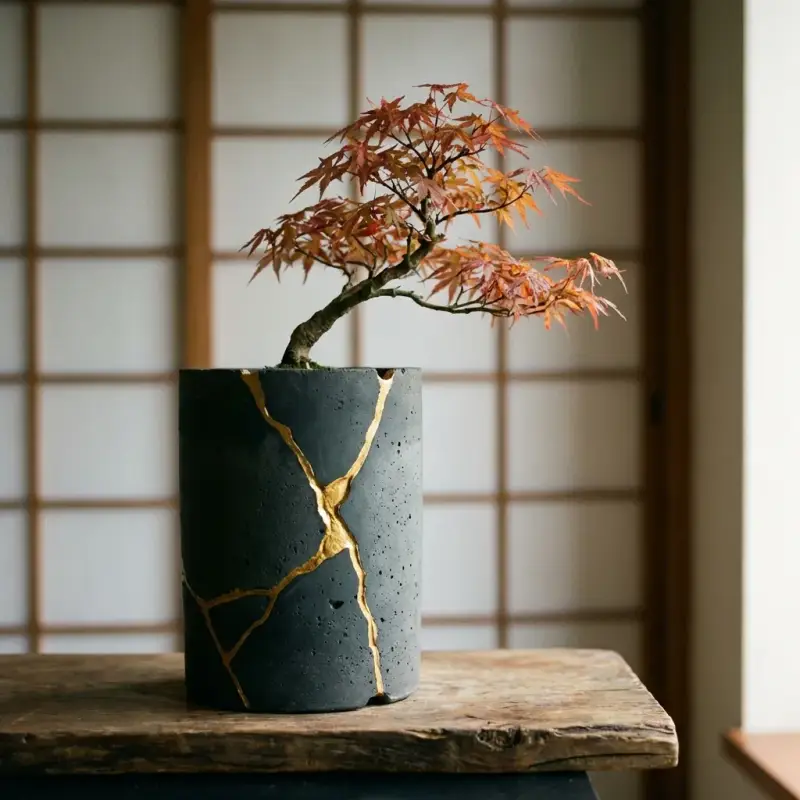
Perhaps the most famous application of Wabi-Sabi is Kintsugi (“Golden Joinery”). When a bowl broke in 15th-century Japan, craftsmen repaired the cracks with gold-dusted lacquer. The flaw became the most beautiful part.
The Wabi-Sabi Approach:
- Widen the Crack: Gently chip away at the fissure.
- The Planting: Let moss spill out of the crack, as if nature is reclaiming the ruin.
- The Gold: Use gold-colored epoxy putty to accentuate the seams. Don’t hide the breakage; celebrate it.
The Modern Mirror: Science Catches Up
The white-coat doctors are finally catching on to what the Zen gardeners knew five centuries ago. What we call Wabi-Sabi (impermanence), they call “psychological flexibility” in their research on Acceptance and Commitment Therapy (ACT).
Studies show that trying to suppress “imperfections”—whether a brown leaf in your tray or a negative thought in your head—only leads to higher stress levels and “experiential avoidance” 1. By practicing Wabi-Sabi in the garden, you are effectively training your brain to handle the real world. You stop being a “master controller” and become a custodian of a process.
Conclusion: The Peace of “Enough”
Wabi-Sabi is ultimately about making peace with the world as it is. In the garden, it relieves you of the burden of perfection. When your stone chips, that is Anicca. When your moss browns, that is the season.
Stop trying to fight the clock. Cultivate a mind that is as resilient and grounded as a weathered stone.