Hidden Music of the Earth: What is a Suikinkutsu?
As an Amazon Associate I earn from qualifying purchases.
Most people use water features as a weapon.
Aquascape AquaBlox Water Storage Modules
Check Current Price on AmazonYou know the type. They install loud, crashing, obnoxious plastic waterfalls to drown out the sound of a neighbor’s air conditioner or passing traffic. It’s a crude, brute-force approach to acoustic masking. Stop trying to fight noise with more noise. It merely increases your ambient visual and auditory processing load, stressing you out in the place you’re supposed to relax.
If you want a garden that actually resonates with the human nervous system, understand the concept of seijaku or visual noise reduction, which we have covered before. But to create a truly immersive experience, we must look to sonic sanctuary design, where the focus shifts from the eyes to the ears.
Enter the ultimate hidden garden feature: the suikinkutsu.
Referred to in the West as a Japanese water harp, the suikinkutsu is an ancient, buried earthen jar that produces a delicate, metallic, harp-like melody when water drips into its hidden cavity. It is a sound meant to be discovered. Not broadcasted across the neighborhood.
The Relaxing Water Sounds History You Never Knew
The history of the suikinkutsu is deeply embedded in Japanese horticulture. It emerged during the Edo period (1603–1867), reaching peak popularity in the Meiji period before suffering a severe decline. By the 1980s? Nobody had heard of one. You literally had to travel to esoteric temples in Kyoto—like Sanbō-in, Konchi-in, or Shoren-in—just to experience the sound. It wasn’t until the Japan Suikinkutsu Forum (established in January 2001) that the art form was saved from extinction. This is the authentic relaxing water sounds history that cheap home-improvement centers completely ignore when they try to sell you a molded fiberglass fountain.
Traditionally, the suikinkutsu is integrated into a tsukubai arrangement—situated directly beneath a carved stone basin used for ritual washing before a tea ceremony. What follows is not a splash, but an intimate, vibrant melody ringing from beneath the ground. As we explore in our guide to mastering ma—negative space, sound is as much about the silence between the notes as the notes themselves. To achieve this, it involves the quintessential Japanese garden feature: the Suikinkutsu (water harp). In our guide to shibui—understated beauty, we discuss how subtle features provide more lasting peace than loud spectacles. The suikinkutsu is the auditory embodiment of shibui.
The Physics of the “Water Koto Cavern”
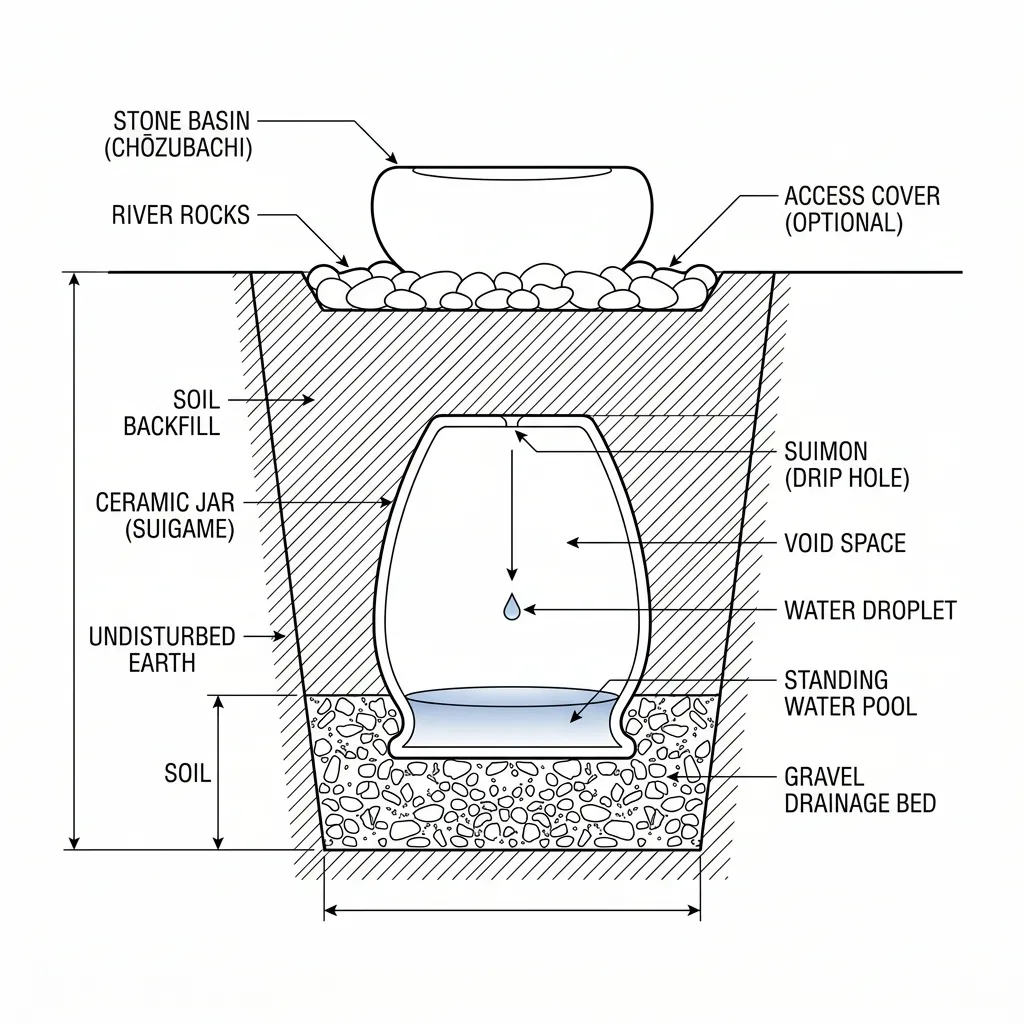
A cross-section showing the subterranean suikinkutsu mechanism.
The mechanics of a Suikinkutsu mechanism demand strict adherence to physics. You cannot simply bury a pot in the dirt and expect it to sing. The physics are demanding, unforgiving, and deeply rooted in acoustic design. Get the physics wrong, and you just have a muddy, silent hole.
The Suikinkutsu Mechanism Explained
The anatomy is deceptively simple: an inverted ceramic pot buried underground, resting securely on a subterranean bed of gravel.
This drainage bed serves a critical dual purpose. Pragmatically? It allows for rapid water drainage. Acoustically? It ensures that the delicate vibrations of the ceramic vessel are not dampened by wet earth. If wet soil touches the resonant bell of the pot, the vibration dies instantly.
At the exact top dead center of the inverted jar is a small aperture, roughly 0.8 inches in diameter. This is the suimon (water hole).
When a single drop of water falls through the suimon, it strikes a standing pool of water at the base of the cavity. This acoustic event has two phases:
- The immediate kinetic impact of the droplet forming an underwater bubble.
- The reverberant, bell-like ringing that propagates upward.
For the sound to be acceptable, it must emit a soothing reverberation characterized by perfectly balanced harmonics. Rigorous acoustic analyses prove the optimal state possesses a fundamental low-frequency component of approximately 1 kHz, supported by high-frequency overtones. This acoustic profile often exhibits pink noise characteristics with specific negative slope values—which is the acoustic equivalent of natural rainfall or a gentle stream, inherently soothing to the human brain.
Generating this precise 1 kHz frequency relies entirely on the natural resonant frequencies (the “eigenfrequencies”) of the ceramic vessel. Think of the jar as a meticulously tuned bell that depends on three factors:
- Material Density: High-fired clay rings; soft clay thuds.
- Internal Volume: The empty space inside must perfectly match the wavelength of the dripping water.
- Structural Integrity: If the ceramic is cracked—even slightly—the resonance dies, and the bell goes silent.
Crucial Note: The hydrodynamic flow of the water must be meticulously regulated. Traditional setups exhibit a precise alteration between ryūsuion (initial drops) and suitekion (consistent falling water). If your flow is too heavy, it overwhelms the chamber. You destroy the rhythmic drops required to activate the cavity’s resonant frequencies.
Compared to other garden sound features, the suikinkutsu stands alone. It doesn’t mask the environment; it enhances the silence around it.
Engineering the Hidden Music: The DIY Mini Suikinkutsu
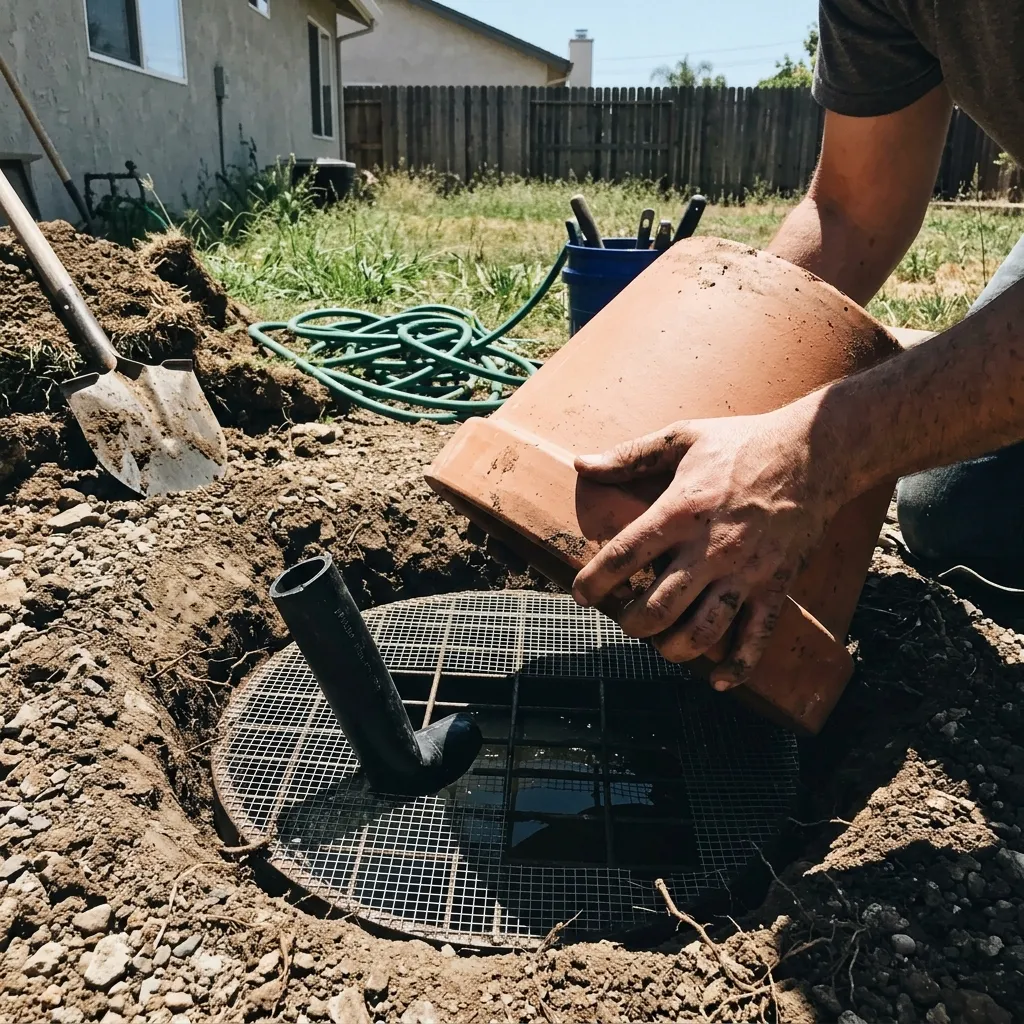
Installing the unglazed ceramic resonator over the prepared basin.
The Pragmatic Material Selection
Before we dig, understand that material choice dictates success or failure.
| Material Type | Acoustic Properties | Structural Integrity | Pragmatic Recommendation |
|---|---|---|---|
| Unglazed Ceramic | Excellent (1 kHz resonance) | High | Required |
| Glazed Ceramic | Good | High | Acceptable |
| Plastic / PVC | None (Dead sound) | Medium | Do Not Use |
| Fiberglass | Poor | Low (Cracks easily) | Do Not Use |
Now let’s get pragmatic. You want to build one. Creating a DIY water feature of this caliber requires a strict synthesis of modern hydraulic materials and ancient acoustic geometry. We are talking about serious zen garden acoustics.
The most common, catastrophic failure in modern water features is the creation of a “top-heavy” system. If your reservoir isn’t big enough to hold the water actively circulating, you get the “soggy sock effect”—your basin overflows when shut off, or starves your pump when turned on. Professional pond basin engineering dictates designing the reservoir to hold two to three times the volume of the water in motion. Do not ignore the math.
Step-by-Step Construction
Before you start digging, understand the commitment:
- Estimated Cost: $250 - $450 (Ceramic Jar: ~$150-$300, Pump & Tubing: ~$40, AquaBlox/Grate: ~$60)
- Estimated Labor: 4-6 hours for excavation and reservoir installation.
Here is the exact, unromantic method for engineering a mini suikinkutsu.
1. Sourcing the Resonator: Source a high-quality ceramic jar, 12 to 40 inches in height. Ask for a high-fired terracotta or stoneware planter without pre-drilled drainage holes. Do not order this blind on the internet. Go to a pottery supplier and physically tap the pot. It must emit a clear, sharp, ringing tone when struck. Traditionalists prefer unglazed interiors. Do not use cheap plastic. It will not work.
2. Reservoir Excavation and Support: Dig a hole to accommodate a deep, heavy-duty plastic water basin. Inside this basin, install a low-wattage submersible fountain pump (paid link).
Warning: To protect the pump impeller from sediment, house it within a mesh flat box filter or a layer of structural Aquascape AquaBlox Water Storage Modules. Instead of buying a fragile, generic plastic tub that will inevitably collapse under the weight of the rocks in a week, use proper structural matrix blocks and build a reservoir that lasts decades. They are infinitely superior for underground water storage capacity compared to dumping a ton of gravel in a hole.
3. The Structural Grate and Trapdoor: Place a heavy-duty metal grate directly over the water basin to support the immense weight. Cover this metal grate entirely with fine wire mesh (hardware cloth). This layer prevents smaller rocks and organic debris from fouling your pump.
Pro Tip: Cut a small trap door into the hardware cloth and grate. When your pump inevitably fails in three years, this trap door allows for maintenance without requiring total, destructive deconstruction. Think ahead.
4. Acoustic Chamber Positioning: Position your inverted ceramic pot centrally above the grate. Route a 1/2-inch flexible vinyl tube (paid link) from the submersible pump below, bringing the water to the surface. Direct this tube to drip water through the suimon at the top of the inverted jar. You must install a precision irrigation drip valve on the tubing, calibrating the flow rate strictly to 1-2 drips per second (approx. 1 pint per hour) to ensure the chamber is not overwhelmed.
5. Aesthetic Concealment: The void beneath the jar maintains a shallow pool of water acting as the target for falling droplets. Conceal the mechanical apparatus with decorative 3-5 inch river rocks. The final result must be the seamless illusion of an invisible spring singing from beneath the earth. This process of refinement is the core of wabi-sabi, emphasizing that beauty lies in the humble, the engineered yet hidden, and the perfectly imperfect sound of falling water.
Modern Amplification: Capturing the Unseen
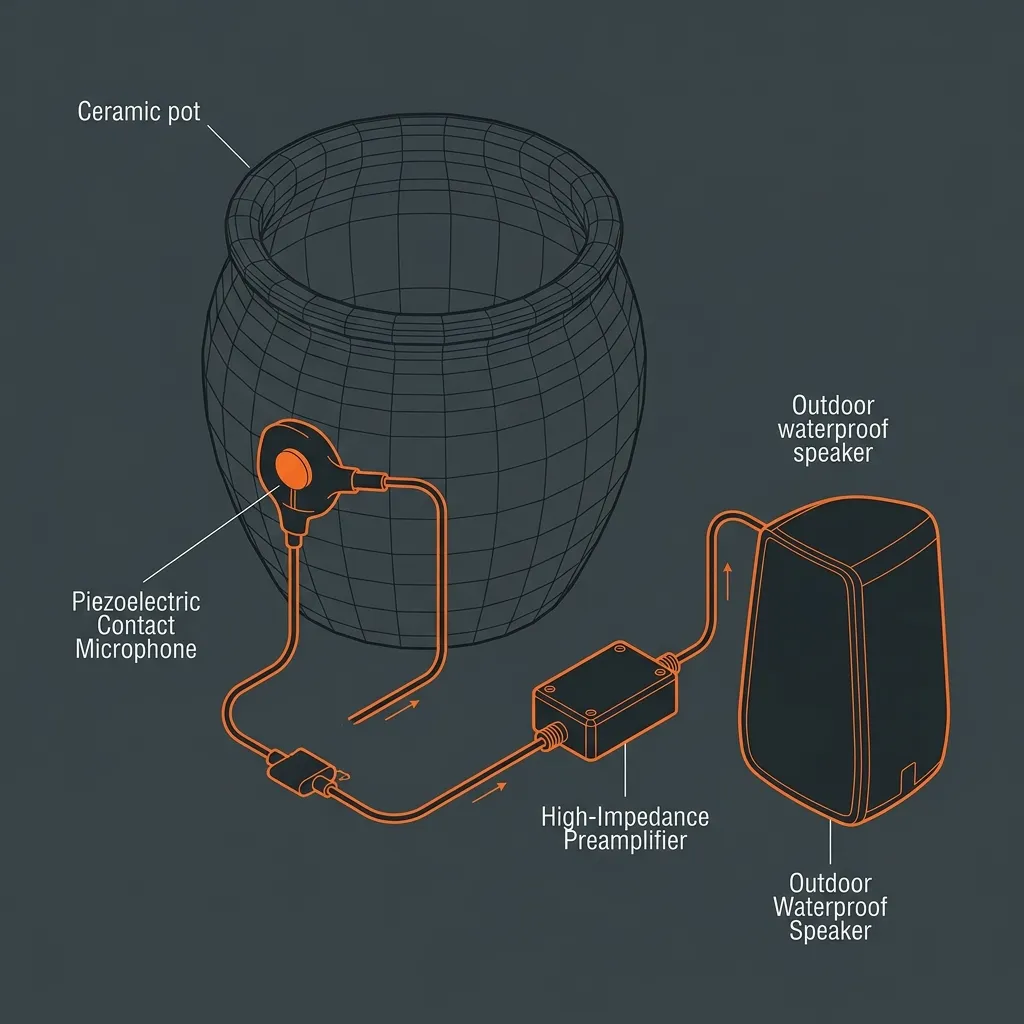
Wiring schematic for the contact microphone and preamplifier setup.
Our modern world is undeniably loud.
Even if you build a perfect suikinkutsu, the ambient noise of a suburban neighborhood might completely drown out the delicate sound. Modern pragmatic design often requires electro-acoustic amplification to capture and broadcast the sound. Yes, purists hate it. But we live in reality.
Historically, listeners used hollowed bamboo tubes placed near the suimon to channel the sound waves. Today, we use electricity.
The Waterproof Contact Microphone
The primary tool for modern amplification is the waterproof stereo contact microphone, specifically utilizing piezoelectric transducers. Do not use a standard air-condenser microphone. The humid, dripping environment will destroy it in an hour. Contact microphones measure the physical, structural audio vibrations of solid objects.
By adhering a heavy-duty, fully submersible Manalive Modular Underwater Contact Hydrophone directly to the exterior wall of the ceramic chamber, you capture the mechanical vibrations of the impacting water droplets and the eigenfrequency resonance of the clay. Instead of trying to wrap a flimsy, exposed $5 condenser mic in plastic wrap that will short out and fry your interface in a week, use a proper, industrially shrink-wrapped transducer designed to withstand constant moisture.
When deployed in a stereo configuration, the system generates a highly textured, three-dimensional ambient sound profile. It brings the ancient Zen meditation tool into the modern era, creating an immersive listening experience.
The Impedance Mismatch Trap
However, there is a massive technical trap waiting. Piezoelectric elements possess extremely high electrical impedance. This is fundamentally mismatched with standard microphone inputs found on consumer audio interfaces.
Crucial Note: If you connect a passive piezo contact microphone directly to a standard audio input, the signal degradation is catastrophic. You will entirely lose the critical 1 kHz low-frequency fundamental. The resulting sound will be dominated by a harsh, screechy treble profile, ruining the meditative intent and driving up processing load.
To resolve this impedance mismatch, you must introduce a high-impedance buffer preamplifier—such as the TritonAudio FetHead In-Line Preamplifier (paid link)—into the signal chain between the microphone and your speaker system. Instead of relying on a cheap, noisy mixer that hisses louder than your water feature, use a proper, shielded inline preamp built for life. This preamplifier conditions the signal, ensuring that the deep, reverberant tones of the hidden water harp are transmitted flawlessly to your speakers.
In the end, building a suikinkutsu is an exercise in mono no aware—honoring the fleeting, delicate nature of a single drop of water. It requires meticulous engineering, a rejection of cheap alternatives, and profound respect for the physics of sound. Stop settling for chaotic noise. Dig a hole, bury a resonant pot, and listen.
KIMAFUN Headset Wireless Microphone System
Check Current Price on Amazon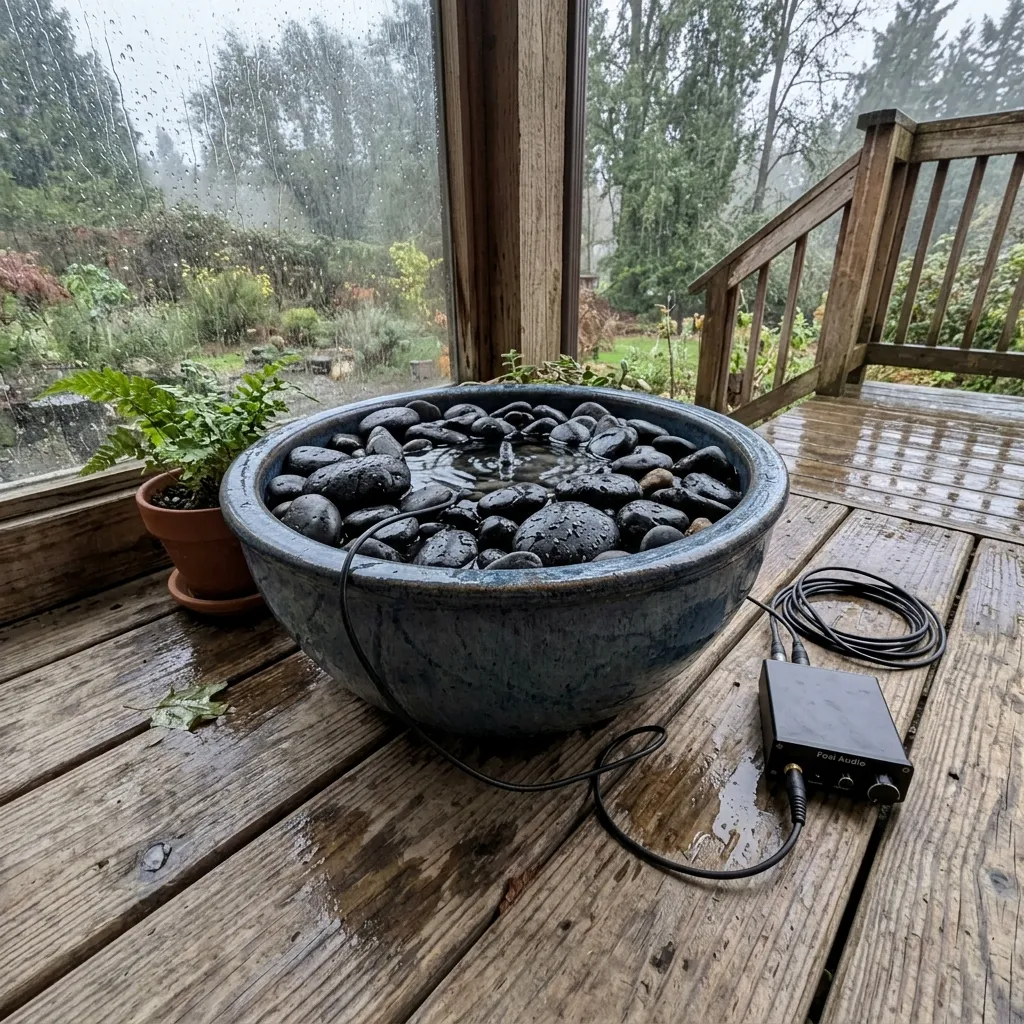
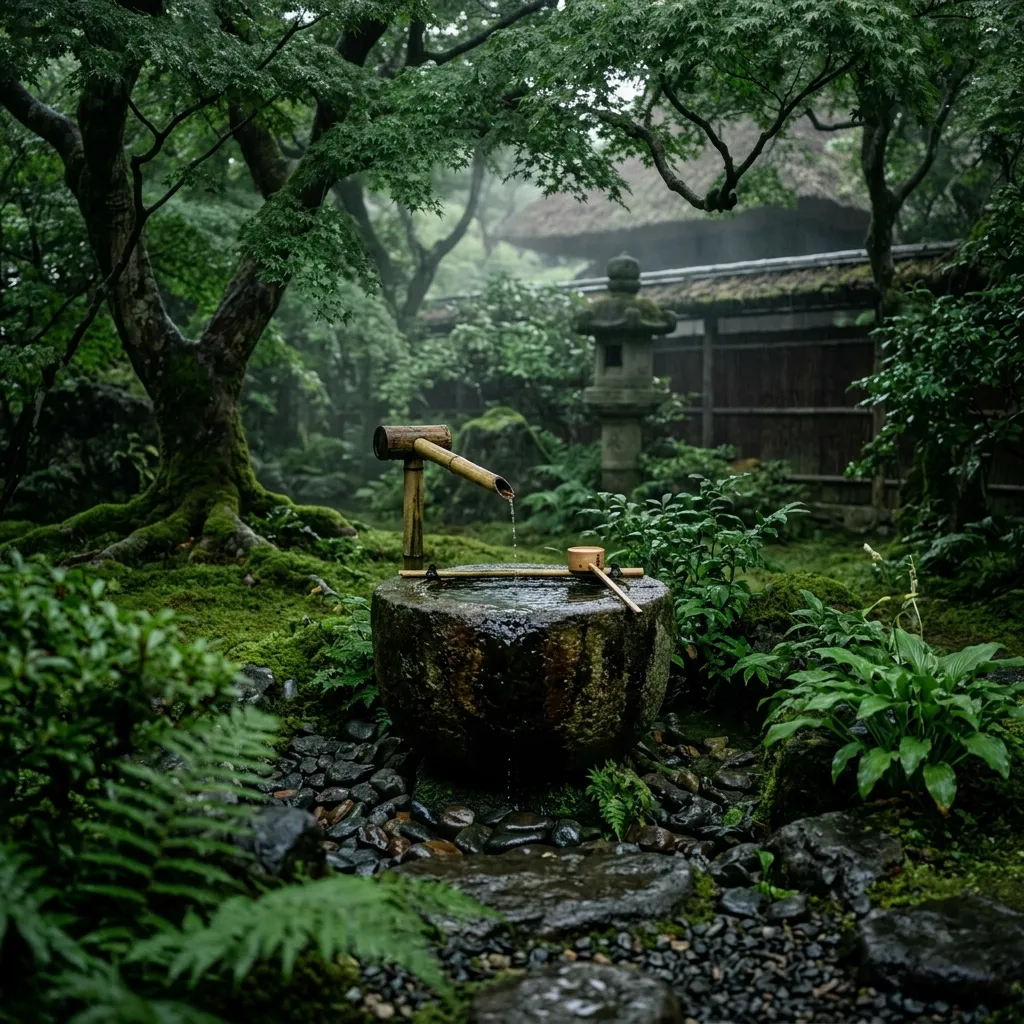
The completed mini-suikinkutsu integrated with modern amplification.