Seijaku: Reducing Visual Noise in Your Personal Sanctuary
Look at your desk right now. No, really. Look at it.
If you’re anything like the executives, it’s a disaster of competing colors, tangled wires, and jagged edges. You probably have a neon-orange stress ball sitting next to a stark-white laptop and a half-dead spiky cactus you bought from a grocery store. And you wonder why you’re exhausted by 2 PM.
Here’s a cynical truth most designers won’t tell you: we aren’t just decorating. We are actively performing visual noise reduction in interior design to protect whatever is left of your mental bandwidth.
At the core of this survival strategy is Seijaku (静寂). Forget the influencer-bland definition of “tranquility.” Seijaku is an energized calm. It’s what happens when you finally stop your environment from screaming at you.
The Cognitive Psychology of Visual Noise
Pro Tip: Visual noise isn’t just a messy room. It’s a cognitive interruption that steals your computation power.
Back in 2018, I watched a VP of Engineering completely melt down during a product sprint. We moved his team from a dim, neutral office into a trendy, “vibrant” open-plan space with bright red accent walls and geometric, jagged furniture. His team’s productivity tanked. Why? Because every time their eyes drifted from the screen, their visual system had to violently restart.
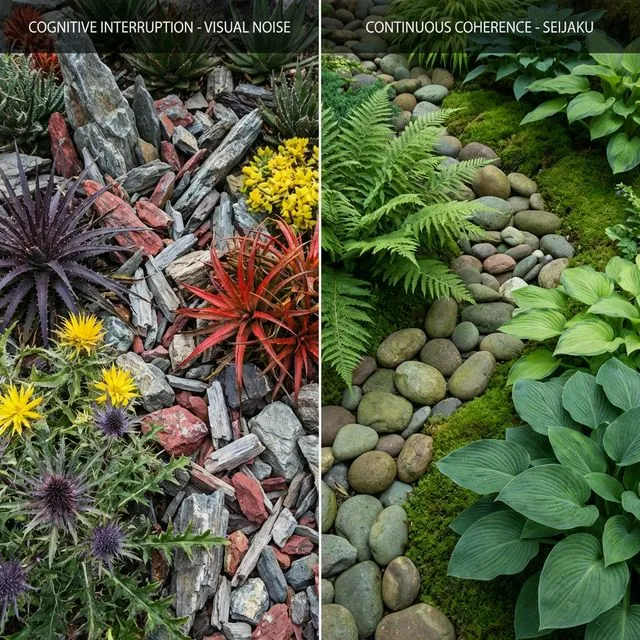
Perceptual noise happens when a space demands constant reorientation. This is UX design 101. When you pack an interface—or a garden bed—with high-contrast, clashing colors like fiery reds and blinding yellows, it creates a “blazing-hot” environment. Sure, it demands attention. But it gives you absolutely zero psychological rest.
But don’t swing to the other extreme. I absolutely hate the sterile “minimalist” aesthetic where a room is just a white box with a single aluminum chair. Stripping a space bare doesn’t create peace; it creates a holding cell. Your nervous system interprets total emptiness as exposure. You get anxious.
What we want in Seijaku interior design is continuous, layered, coherent visual density.
Visual Noise vs. Visual Calm
| Design Element | The Interruption (Visual Noise) | The Coherence (Seijaku) |
|---|---|---|
| Shapes | Jagged rocks; spiky, aggressive foliage | Smooth, rounded river stones; sweeping curves |
| Colors | High-contrast clashing (red next to yellow) | Cohesive, monochromatic gradients |
| Flow | Fragmented, purely decorative | Connected, meandering; organic layouts |
| The Vibe | Hyper-vigilant, teeth-grinding tension | Energized calm. Clarity. |
Seijaku: Active, Not Passive
Seijaku isn’t the absence of sound. It’s an active, deliberate state.
If you want to understand how it works, you have to look at how it plays with other Japanese design principles:
- Ma: The negative space. The pause between the notes.
- Yūgen: A subtle, mysterious depth. Not everything needs to be brightly lit.
- Wabi-sabi: The weathered, the imperfect. Stop trying to make everything look plastic.
You don’t need a silent forest retreat to get this. You just need to organize your immediate surroundings.
The “Quiet” Garden: Monochromatic Palettes
If you want practical calming garden design, use a monochromatic palette.
I see people searching for monochromatic garden ideas all the time, but they miss the point. We use one main color—say, green—and play with its tints and shades. This stops the plants from blending into a chaotic soup. Warm colors excite. Cool colors—blues, purples, soft greens—quiet the mind.
I pitched a white moon garden design to a client recovering from extreme burnout. We used white blossoms alongside silver foliage. The ‘Big Daddy’ Hydrangea for mass, Wisteria for vertical flow, and Sweet Violet on the ground. At night, the garden literally glows. It’s elegant. And best of all, it doesn’t shout.
2026: The “Rewilded” But Organized Space
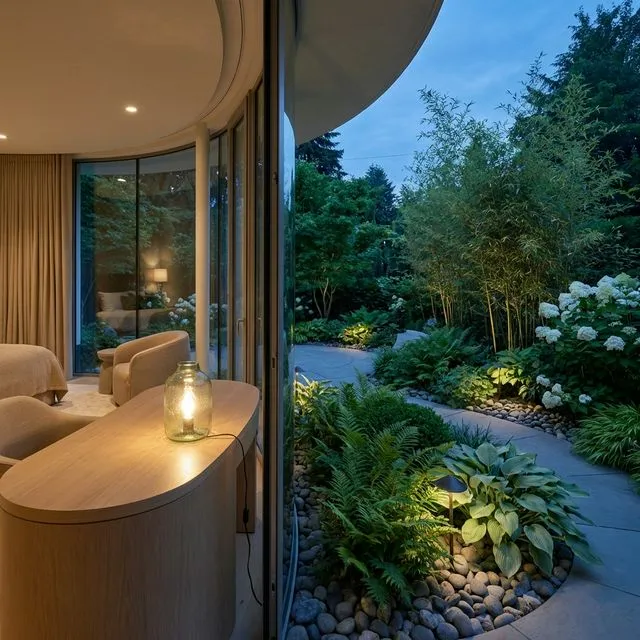
Zen garden design trends 2026 are shifting away from hyper-manicured, rigid lines. We’re moving toward organic flow.
Straight paths are out. Curved stone paths that force you to slow down are in. And please, drop the roaring waterfalls. We’re integrating sonic minimalism now—bamboo trickles over a dry riverbed.
You might think a “rewilded” yard violates Seijaku. It doesn’t. A messy yard is fine as long as it follows the continuous, non-repetitive fractal patterns of nature. Our brains process natural density effortlessly. It’s angular, artificial clutter that fries our nerves.
The Physical Transition (Closing the Gap)
Here is the most expensive mistake I see clients make. They spend a small fortune designing a tranquil backyard sanctuary, only to walk back inside and sit at a desk that looks like the aftermath of an electronics explosion.
The psychological benefits of your outdoor Seijaku evaporate the second your eyes hit a tangle of HDMI cables and fluorescent Post-it notes. The brain doesn’t compartmentalize stress. A cognitive interruption is a cognitive interruption, whether it’s a jagged, clashing garden bed or a disorganized workspace. To actually protect your mental bandwidth, you must actively connect the patio and the office by adopting neuro-restorative practices. The visual calm has to follow you inside.
The Office Sanctuary
A peaceful desk setup is your absolute first line of defense against cortisol spikes during the workday.
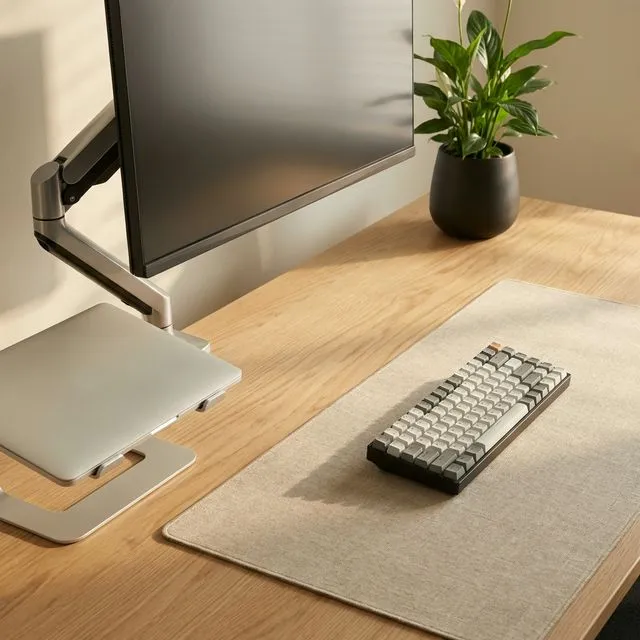
You want to stop grinding your teeth at 4 PM? Try this:
- Get Ergonomic: A standing desk and an eye-level monitor physically signal your brain that the environment is safe.
- Hide the Wires: Use under-desk trays. Tangled wires are cognitive poison. Focus.
- The Two-Minute Tidy: I don’t care how tired you are. Clear your desk at 5 PM. Leaving clutter is leaving unconscious chores for tomorrow.
- Add Life: Get a micro-sanctuary element. A bonsai or peace lily in a matte ceramic pot. One organic focal point.
Stop buying more things. Start removing the visual noise.