Saikei vs. Bonkei: Which Tray Landscape is Right for You?
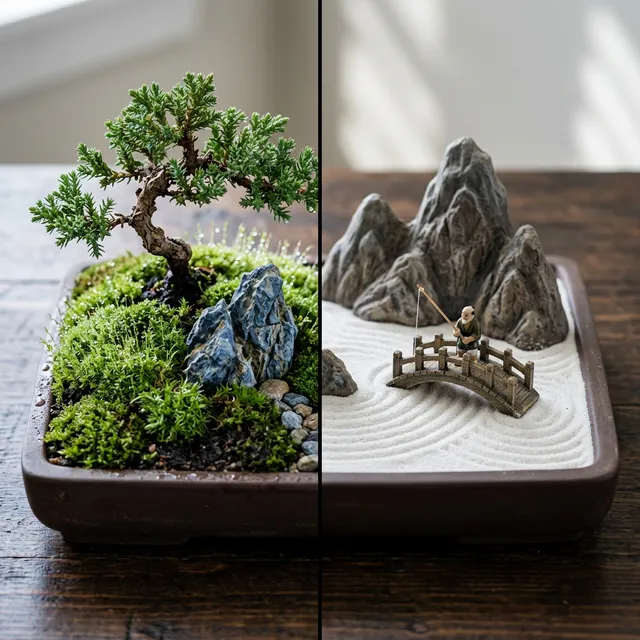
You’re about to buy the wrong thing. I see it every single day.
People walk into the shop holding a screenshot of a stunning, lush tray garden, completely unaware they are looking at a living Saikei, and they ask me where to buy the tiny plastic fishermen they saw in a dry Bonkei diorama. They mix the two up. Then they buy high-carbon steel pruning shears for a plastic tree, or worse, they throw moisture-retaining polymers into a shallow tray and wonder why their living root system turns into stinking black mush.
Let’s establish the ground rules. If you don’t know the difference between Saikei vs Bonkei, you are setting yourself up for failure. One is gardening; the other is model-making. Get it wrong, and you’re just throwing money in the trash.
The History Lesson Nobody Asked For (But You Need)
Before we start arguing over soil mix ratios, let’s get our facts straight. Both these Japanese tray landscape types started from the Chinese practice of Penzai (tray plant)1. But they split. Hard.
Bonkei literally translates to “tray landscape.” And it’s centuries old. Back in 1848, Utagawa Yoshishige made it famous by depicting the fifty-three Stations of the Tōkaidō as contained scenes2. What is it, really? It’s a dry art form. It’s a diorama.
Saikei (“planted landscape”), on the other hand, is the new kid on the block. Toshio Kawamoto created it after World War II3 because traditional bonsai—with its intense, monastic focus on a single, tortured tree—was too intimidating for regular folks. Saikei is messy. It integrates rough stones to build topography and mixes living plants together. It’s a great bridge if you ever want to get into the heavy stuff over in our The Art of Wabi-Sabi guide.
The Core Argument: Living Horticulture vs. Diorama Crafting
Here is my controversial take for the day: I actually prefer Bonkei for 90% of my clients. Why? Because most people treat plants like decorative furniture. If you want a static ornament, don’t buy a living organism.
The Saikei Approach: A Volatile, Living Micro-Ecosystem
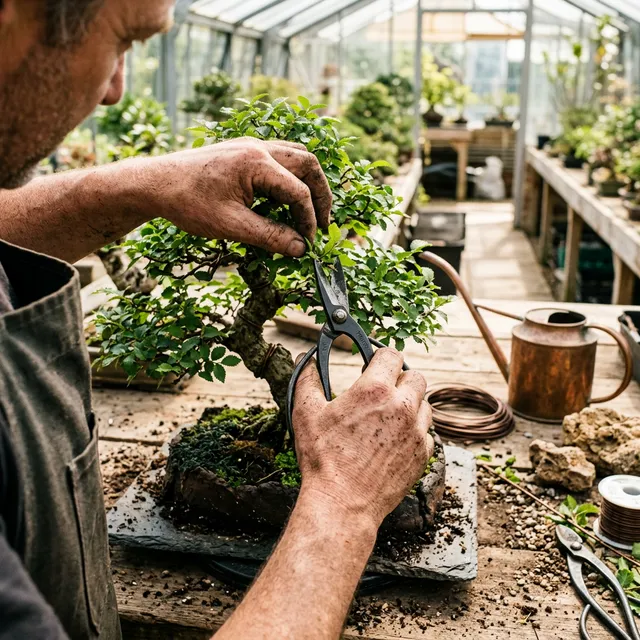
Saikei is a living, breathing, dying thing. You use younger tree stock—Chinese Elm, Junipers—because you want an immediate scene. You are literally building a forest floor with damp potting soil, organic moss ground cover, and water.
Because it’s alive, it fights back. Trees grow in the wrong direction. Leaves drop. If you ignore a Saikei for a week while you go to Cabo, you come back to a tray of dry kindling.
The Bonkei Method: The Static, Dry Landscape Diorama
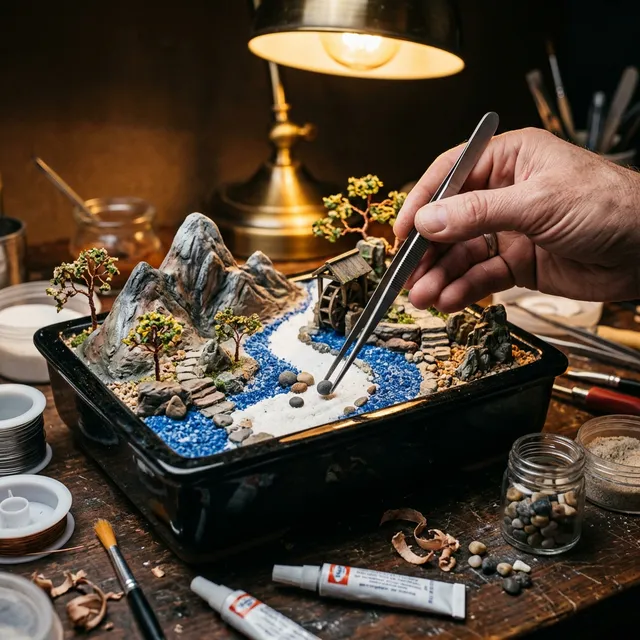
Bonkei bans living plants. Period.
You aren’t a gardener; you are a sculptor. You use cement, potter’s clay, papier-mâché, and white sand. You get to proudly use highly detailed ceramic figurines—bridges, huts, little fishermen—to tell a story. Once that clay cures? You’re done. You can slap that tray on a Mono no Aware Desk and never water it.
Sourcing Your Inventory: The Cost of Creation
I once had a guy spend $150 on hand-forged Wazakura shears to trim a plastic tree. Don’t be that guy.
Saikei Tools and Materials
You are keeping roots alive in an absurdly shallow space.
- Organic Planting Soil: Absolutely no chemical fertilizers.
- Muck: A sticky mix of fine soil, clay, Akadama dust, and sphagnum moss. You literally build walls with it.
- Specialized Japanese Steel: Professional twig scissors and concave branch cutters. (Crucial, or you’ll mangle the branches).
- Inert Stones: Seiryu Stone, Tufa Rock.
Bonkei Artificial Materials
Leave the soil outside.
- Sculpting Mediums: Bulk air-dry clay. Two-part epoxy putty (like Milliput or Apoxie Sculpt).
- Topography: Colored sand, crushed pebbles, acrylic paint. (Search for “DIY diorama kits” to start cheap).
- Precision Tools: Tiny paint brushes and crafting tweezers.
- Synthetic Flora: Wire and paper trees.
Table: Comparative Analysis of Material Investments
| Aspect | Saikei Requirements | Bonkei Requirements |
|---|---|---|
| Base Mediums | Live soil, organic mulch, “muck” for walls | Air-dry clay, epoxy putty |
| Tools | High-carbon steel branch cutters, shears | Precision tweezers, paintbrushes |
| Topography | Living moss, live bark, abstract inert stone | Crushed pebbles, dyed sand |
| Flora | Live Juniper, Elm, Myrtle | Paper, plastic, and wire faux plants |
Pro Tip: In Bonkei, splurging on surgical tweezers is non-negotiable for placing minute pebbles. In Saikei? If you buy cheap pruning shears, you will physically crush the stems of your living plants instead of cutting them. Bite the bullet and buy the good steel.
The Beginner’s Decision Matrix
Stop romanticizing this. Look at your actual lifestyle.
Decision Matrix: Saikei vs. Bonkei
| Decision Parameter | The Saikei Path (Planted Landscape) | The Bonkei Path (Dry Landscape) |
|---|---|---|
| Primary Required Skillset | Botany, horticultural pruning, watering cadence | Fine sculpting, acrylic painting |
| Ongoing Maintenance Burden | Brutally High (moisture checks, seasonal pruning) | Extremely Low (dust it off every few months) |
| Environmental Prerequisites | Strict indoor lighting (grow lights or a bright south-facing window) | Put it in a dark basement if you want. |
| Lifespan and Dynamics | It grows. It changes shape. It might die. | Frozen forever. |
| Integration of Figurines | Generally avoided. Let abstract shapes talk. | Highly encouraged. Build your tiny village. |
The fastest way to murder a tree is bad lighting. So, if your desk is in a dim corner and you want a $30, zero-maintenance project, give Bonkei a whirl. It’s safe. It’s clean.
But if you actually want to get your hands dirty? If you want the brutal, rewarding reality of keeping a tiny forest alive on your kitchen table? Grab some soil and start building a Saikei. Which kind of frustration sounds better to you?
Further Reading
- 5 Best Ferns for Your Pocket Terrarium
- Shizen: Zen Garden Upgrade
- The Art of Wabi-Sabi
- Mono No Aware: The Aesthetic of Passing Time
Footnotes
-
Penzai (or Penjing) originated in China over 1,300 years ago during the Jin and Tang dynasties, serving as the foundation for Japanese tray landscapes. Read more on Wikipedia. ↩
-
In 1848, Ukiyo-e artist Utagawa Yoshishige published Tokaido Gojusan-eki Hachiyama Edyu (Fifty-three Stations of the Tōkaidō as Potted Landscapes), cementing the aesthetic of Bonkei dioramas. View the prints. ↩
-
Toshio Kawamoto developed Saikei as an accessible horticultural art following the post-war decline of traditional Bonsai in Japan. Learn about Kawamoto. ↩