Climate-Adaptive Zen Sanctuary Design
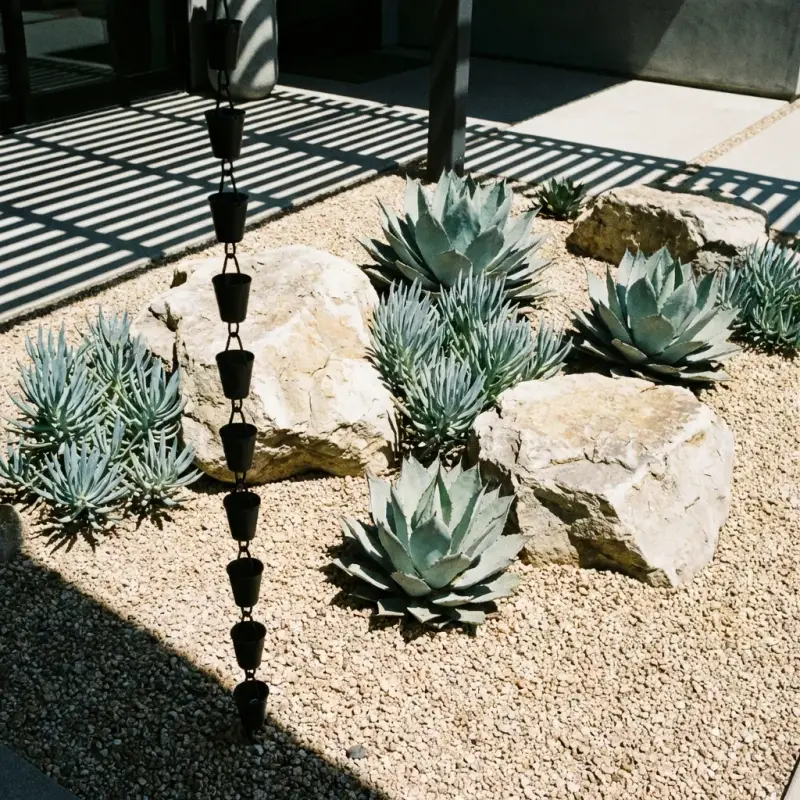
As an Amazon Associate I earn from qualifying purchases.
A true sanctuary shouldn’t require a municipal water utility to keep it alive. Trying to maintain a lush, moss-heavy landscape in an arid climate isn’t peaceful; it’s an expensive war of attrition against nature itself. If your idea of relaxation involves pumping hundreds of gallons of water onto a patch of grass just to keep it from crisping up in July, you need a new approach.
Teralytic Wireless Soil Moisture Sensor
Check Current Price on AmazonThe most common trap in modern residential landscaping is fighting the local climate. We’re bleeding dry trying to maintain an English lawn in an era of droughts and sudden heatwaves. It’s time to cut the cord and stop forcing nature to be what it isn’t—a concept heavily tied to the Japanese principle of naturalness, or Shizen.
True Wabi-Sabi isn’t just about admiring a cracked teacup. It’s about adapting to the brutal reality of what’s outside your window. We’ve shifted hard toward what we call Dry Zen. No, I don’t mean just chucking a cactus in a pot. I mean curating a deliberate palette of silver, sage, and stone that laughs at a heatwave—a design that lowers both your water bill and the visual noise of high maintenance.
The Problem With Concrete: Stop Baking Your Yard
Before we plant a single thing, we need to talk about grading and hardscaping.
Concrete is dead to me. Pour a solid concrete slab in a sunny yard and you’ve just built a thermal battery that cooks your space all night. Dark stones, like basalt, look moody and dramatic in a magazine, but in a real-world heatwave? They become radiators. Your garden is suddenly unusable past 6 PM.
If you don’t adapt your hardscaping, your plants will fry and every heavy rain will become a flash flood racing into the municipal drain instead of feeding your soil.
The Solution: Permeability and Hydro-Zoning
To build a sanctuary that survives, we have to engineer the environment to absorb water when it falls, and ration it when it doesn’t.
1. High-Albedo Permeable Pavement
Your patio needs to be a filter, not a dam.
- Bonded Gravel: We glue crushed granite together with a UV-stable resin binder. You get the crunch of loose stone, but it’s solid underfoot. Rain goes right through to the aquifer like pouring water through a sieve.
- Open-Joint Slate: Float massive, light-colored stone pavers—like beige limestone or travertine—on a bed of crushed aggregate. No mortar. This albedo shift (using light reflective colors) drops the micro-climate temperature by a solid five degrees, making the space habitable during peak summer.
2. Hydro-Zoning That Actually Works
Most “smart irrigation” setups are just dumb timers with WiFi. The early 2020s were littered with them. We need rigs that actually think.
I’m talking about Predictive Hydro-Intelligence. Systems like Rachio Gen 4+ or Hydrawise pulling data from hyper-local weather stations—literally the one mounted on your fence. If it’s about to rain, or if the evapotranspiration rates are off the charts, the system adapts. Right then.
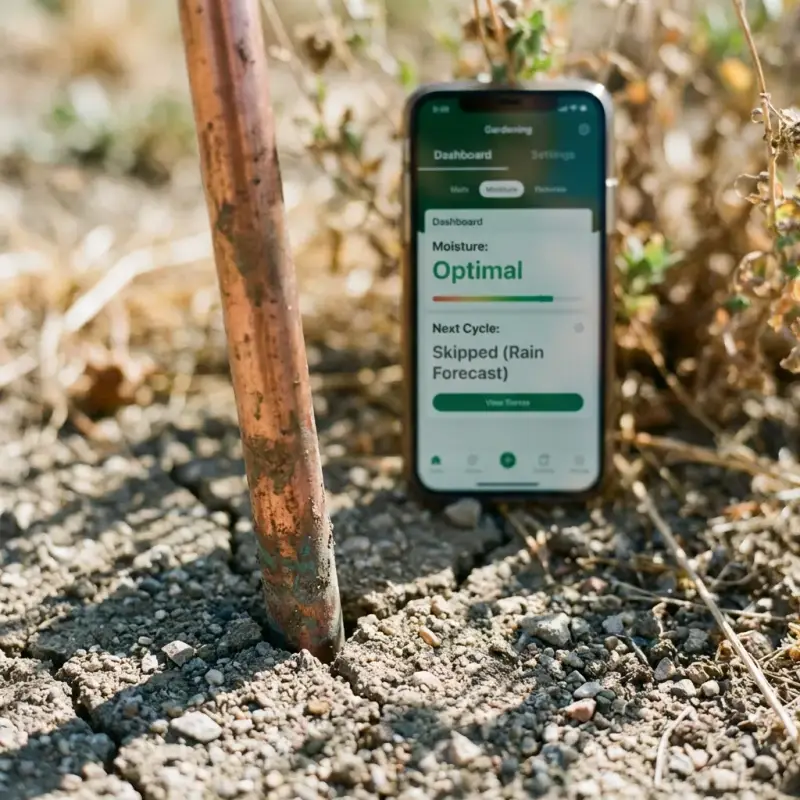
- Soil Capacitance Sensors: For accurate tension readings, install ceramic soil moisture sensors (like Teralytic or Watermark) at a depth of 6 to 8 inches, ensuring they are placed within the active root zone of your primary anchor plants, not just the gravel bed. They read moisture tension and NPK levels. They tell the rig exactly when a plant is actually thirsty.
- Sub-Surface Drip: Stop spraying water into the air. It evaporates before it hits the dirt. Inject it directly to the root zone with capillary mats.
The “Silver Zen” Plant Hit List
If you’re working with a hot, sun-baked patio, drop the thirsty ferns. We’re leaning hard into shimmering silvers—plants that evolved reflective coatings (trichomes) just to survive being baked alive. By selecting these, we achieve profound beauty without resource anxiety.
| Species | The Job | Toughness | Why It Works |
|---|---|---|---|
| Black Mondo Grass (Ophiopogon planiscapus) | Ground Cover | Moderate | Kicks moss to the curb. Deep, dramatic voids of negative space. |
| Blue Fescue (Festuca glauca) | Texture | High | Soft, geometric spheres. Handles the visual job of a fern without needing a swamp. |
| Japanese Black Pine (Pinus thunbergii) | Structure | Very High | The classic Zen anchor. Shrugs off salt, wind, and drought once established. |
| Agave ‘Blue Glow’ | Focal Point | Extreme | Living architectural geometry. A statement piece that thrives on neglect. |
The Modern Kusari-doi (Rain Chain)
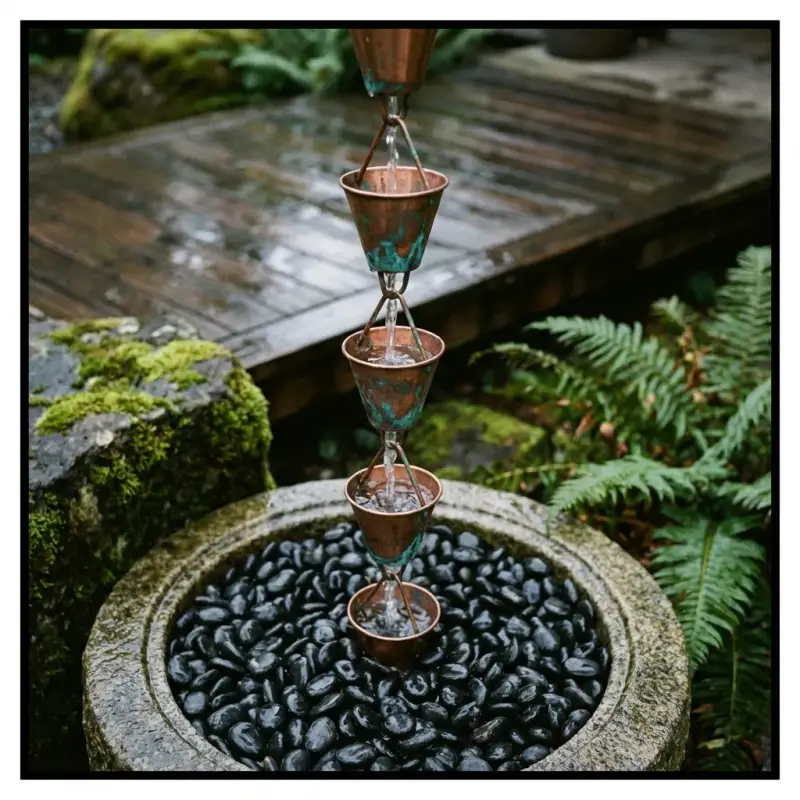
When you live somewhere hot and dry, rain isn’t an annoyance; it’s an event. Instead of hiding it in an ugly aluminum downspout, we expose it with a copper rain chain (Kusari-doi).
While a high-quality copper rain chain might run $150 to $300—significantly more than a standard aluminum downspout—the investment pays off by eliminating the need for complex, buried drainage pipes and providing a visual, low-maintenance focal point.
Position the rain chain over a catchment basin filled with 1-inch to 2-inch river rock. Dig a trench 18 inches deep, line it with non-woven landscape fabric, and install a 4-inch perforated PVC pipe to route the overflow safely away from the foundation.
The Hidden Gem: The Water Koto Cavern (Suikinkutsu)
To push your drought-tolerant sanctuary further, don’t just capture water—make it sing. The ultimate expression of hidden design and acoustic physics is the Suikinkutsu, or the “Water Koto Cavern.”
Historically developed in the Edo period, the Suikinkutsu was a brilliant way to handle drainage near a traditional chozubachi (water basin). Instead of just letting the runoff soak into the mud, Japanese garden masters buried a large, inverted clay pot beneath the gravel. As water drips through a hole at the top, it hits a shallow pool of water inside the resonant chamber of the pot, creating a distinct, metallic splashing sound that echoes up through the ground—mimicking the pluck of a traditional Japanese Koto string instrument.
The Physics of the Chime
The magic of the Suikinkutsu relies entirely on acoustic resonance and fluid dynamics. When a drop of water falls, it creates a cavity in the resting water below, followed immediately by a rebounding column of water and an air bubble that pinches off. The popping of that bubble creates the sound wave. The inverted clay pot acts as a Helmholtz resonator. If the volume of the pot and the size of the drainage hole are properly tuned, the specific frequencies are amplified, turning a dull drip into a musical chime.
In a dry climate, you don’t need a constant flow of municipal water to achieve this. A slow drip from a rain chain or a small, recirculating 5-gallon reservoir is enough.
DIY: Building a Balcony-Friendly Mini Suikinkutsu
You don’t need a massive yard to build this. We can engineer a closed-loop, miniature Suikinkutsu perfect for an urban apartment balcony or small patio for under $150.
Materials & Cost Breakdown
- Outer Container: A 15-gallon waterproof glazed ceramic (paid link) or resin planter (must have no drainage holes or have them sealed). Estimated Cost: $45
- Resonant Chamber (The Pot): A 3-gallon unglazed terra cotta pot. Estimated Cost: $15
- Gravel Base & Drainage: 1 bag (50 lbs) of 3/4-inch washed river rock and 1 bag (50 lbs) of 1/4-inch pea gravel. Estimated Cost: $12
- Pump & Tubing: A small 50 GPH to 100 GPH submersible aquarium pump (paid link) with 1/2-inch clear vinyl tubing (about 3 feet). Estimated Cost: $20
- Support & Mesh: A section of rigid hardware cloth or a heavy-duty plastic grate to cover the large planter, and fine fiberglass window screen mesh (paid link) to catch debris. Estimated Cost: $15
- Surface Decorative Stones: Polished black river stones or Mexican beach pebbles. Estimated Cost: $25
- Bamboo Spout (Optional): Pre-made bamboo fountain spout (Tsukubai style). Estimated Cost: $15
- Total Project Cost: ~$147
Step-by-Step Construction
Step 1: Prep the Resonant Chamber Take your 3-gallon terra cotta pot. Ensure it has a standard drainage hole in the bottom (this will become the top hole when inverted). This hole should be about 1 inch to 1.5 inches in diameter. If it’s too small, carefully widen it with a masonry bit.
Step 2: Establish the Foundation Place the large 15-gallon waterproof container in its permanent spot on your balcony (it will be extremely heavy once filled). Place the small submersible pump at the very bottom center. Run the power cord up the inside wall. Add about 2 inches of the 3/4-inch river rock into the bottom to stabilize the pump. Pour in exactly 2 gallons of water. This creates the resting pool the drips will strike.
Step 3: Invert the Chamber Take the 3-gallon terra cotta pot and place it upside down inside the larger container, resting directly over the pump. The pump should be completely covered by the terra cotta pot. The drainage hole of the terra cotta pot is now facing up. Ensure the terra cotta pot sits level on the base rock.
Step 4: Route the Plumbing Snake the 1/2-inch vinyl tubing from the pump up through the 1-inch hole in the inverted terra cotta pot. Leave a little slack.
Step 5: Fill the Void Carefully pack the empty space between the outside of the terra cotta pot and the inside wall of the large 15-gallon container with the remaining 3/4-inch river rock, up to the top level of the inverted terra cotta pot. This locks the resonant chamber firmly in place. Do not let gravel fall into the hole.
Step 6: The Support Grate & Mesh Cut your rigid hardware cloth or plastic grate to fit perfectly over the top of the entire setup. It should rest on the river rock and the top of the terra cotta pot. Next, lay a layer of fine window screen mesh over the grate. This prevents debris from clogging the chamber. Poke a small hole in the mesh to pull your vinyl tubing through.
Step 7: The Surface Level & Spout Cover the mesh completely with your decorative polished stones (about a 2-inch layer). Attach your bamboo spout to the vinyl tubing, resting it on the decorative stones. Position the spout so it drips directly over the center where the hole in the terra cotta pot is buried beneath the stones.
Step 8: Tuning Plug in the pump. You want a slow, steady drip, not a rushing stream. You may need to pinch the vinyl tubing slightly with a zip tie to restrict the flow. As the water drips down through the stones, through the mesh, and into the hole of the terra cotta chamber, it strikes the 2-gallon pool below.
If built correctly, you will hear a distinct, echoing “plonk” sound resonating up through the stones.
Monarch Pure Copper Kusari-doi (Rain Chain)
Check Current Price on AmazonAttachment causes suffering. The second you let go of your desperate attachment to a lush, tropical oasis in the middle of a dry climate, you find something vastly better. A stoic, durable space that drinks exactly what it needs, stands firm when the temperature spikes, and brings the quiet acoustic magic of the Suikinkutsu to your daily life.