Mono no Aware: The Art of the 'Good Goodbye' on Your Desk
The Philosophy of the “Good Goodbye”
Let’s be honest: do you panic when you see a yellow leaf on your Pothos? Do you treat your indoor garden like a museum exhibit that must remain frozen in time?
In the West, we’ve turned “plant care” into a fight against death. We fill our desks with plastic-looking succulents that never change and feel like failures when a flower fades. This obsession with permanent perfection creates a workspace that is not just static—it’s stagnant. It disconnects us from the very nature we’re trying to bring indoors.
This is the exact opposite of Japanese aesthetics.
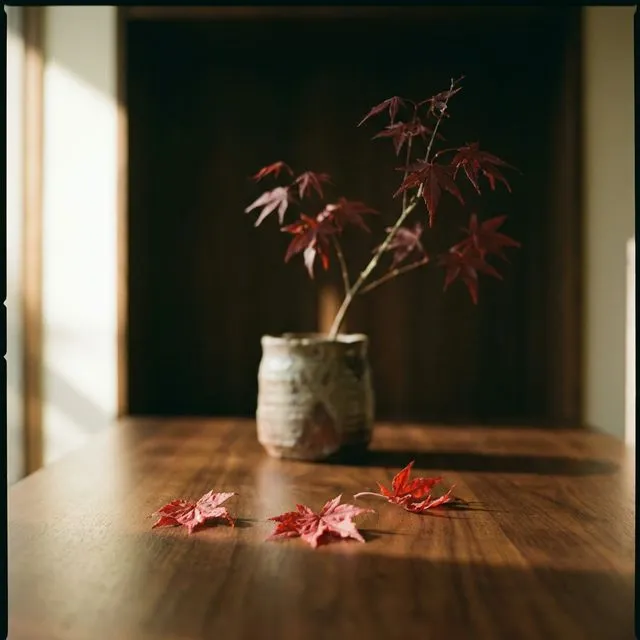
While Wabi-Sabi celebrates the “old,” Mono no aware (物の哀れ) celebrates the “fleeting.” It is the bittersweet realization that the most beautiful things—cherry blossoms, autumn leaves, youth—are beautiful because they do not last. For the indoor gardener, this means shifting focus from “keeping plants alive forever” to “curating moments of seasonal change.”
Mono no aware, a concept central to the Heian Period (794–1185) but crystallized by 18th-century scholar Motoori Norinaga, translates roughly to “the pathos of things.” It’s the emotion you feel when you watch Sakura (cherry blossoms) fall. It isn’t grief; it’s a gentle, wistful appreciation of Mujō (impermanence).
If Wabi-Sabi Wabi-Sabi is about the beauty of the weathered rock, Mono no aware is about the beauty of the falling leaf.
Why does this matter for your desk? Because a workspace that is frozen in time creates stagnation. A workspace that honors the seasons creates flow.
The Design Strategy: The Seasonal Altar
To bring Mono no aware indoors, you have to stop treating your desk as a storage unit. Treat it as a Tokonoma (a traditional display alcove). You aren’t just decorating; you are staging a performance of time.
1. Curating “Transient Beauty”
Most indoor plants (Pothos, Snake Plant) are chosen because they look the same year-round. To capture transient beauty, you need plants that do something.
| Plant | The “Mono no Aware” Moment | Season |
|---|---|---|
| Japanese Maple Bonsai (Acer palmatum) | The turning of the leaves from green to blood red, and finally, the bare branch. | Autumn |
| Azalea Bonsai (Rhododendron) | The explosion of pink blooms that lasts only two weeks. | Spring |
| Paperwhite Narcissus | The rapid growth and intense scent, followed by immediate decline. | Winter |
| Kusamono (Accent Grass) | The drying and browning of the grass stalks. | Autumn/Winter |
2. The “Fallen Leaf” Tray
Pro Tip: Here is a radical design move: Don’t you dare sweep up the leaves immediately.
When your Japanese maple bonsai drops its leaves, they aren’t trash. They’re the art.
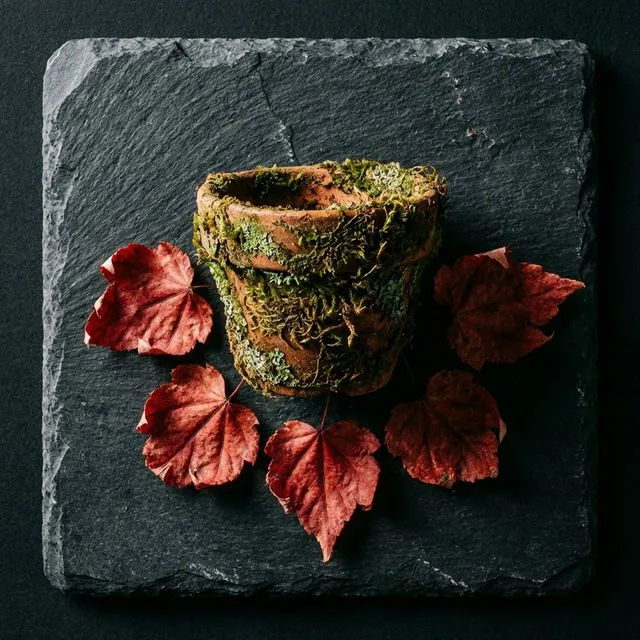
- The Technique: Place your bonsai pot on a wide, flat ceramic tray or a slab of slate.
- The Act: As leaves fall, let them pile up on the slate for 3-4 days. Nudge them slightly if you have to, but keep it natural.
- The Mindset: View this red carpet of leaves as the climax of the tree’s year, not a mess to be cleaned.
Mono no Aware vs. Wabi-Sabi: What’s the Difference?
These two concepts are cousins, but they are not twins. Using them correctly is key to authentic Zen design.
| Feature | Wabi-Sabi | Mono no Aware |
|---|---|---|
| Core Focus | Material (The Object) | Time (The Event) |
| The Symbol | The Weathered Rock | The Falling Leaf |
| The Example | A rusted iron lantern | The dying flame inside it |
| The Feeling | Appreciation of Age | Appreciation of Loss |
If you have a rusted iron lantern on your desk, that is Wabi-Sabi. If you light a candle inside it and watch the flame flicker and die, that is Mono no aware.
Practical Application: The 4-Season Desk
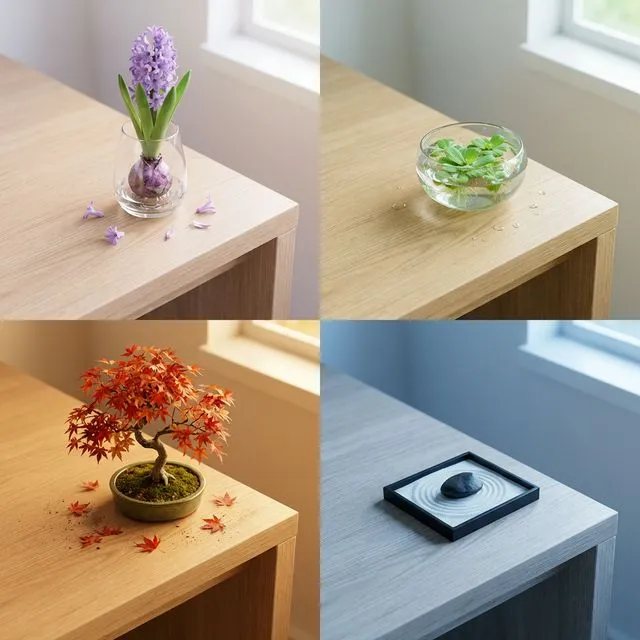
You don’t need a greenhouse to do this. You just need to rotate one element. This connects your isolated indoor environment to the real world outside.
Spring: The Awakening
- Action: Force a bulb (Hyacinth or Muscari) in a glass vase.
- The Feeling: Anticipation. Watching the green shoot break the dormancy.
Summer: The Lushness
- Action: A small bowl of floating aquatic plants or a Submersive Sanctuary.
- The Feeling: Vitality and coolness.
Autumn: The Release
- Action: A deciduous bonsai or a simple vase with a dried branch.
- The Feeling: Melancholy and letting go. This is the peak of Mono no aware meaning.
Winter: The Void
- Action: A Shibui arrangement. A single rock, raked sand, no plants.
- The Feeling: Silence and rest.
Conclusion: Feeling the “Ah-ness”
The scholar Motoori Norinaga1 described Mono no aware as the “sigh” you make when you deeply understand the heart of things.
In a high-speed, digital world, we rarely sigh. We scroll. We click. We rush.
By inviting seasonal indoor plants that live, bloom, and yes, die onto your desk, you force yourself to slow down. You acknowledge that this moment—this email, this stress, this afternoon sunlight—is fleeting. And because it’s fleeting, it’s precious.
Don’t just build a garden that looks good. Build a garden that tells you what time it is.
Footnotes
-
Norinaga, Motoori. The Poetics of Motoori Norinaga. University of Hawaii Press. He defined “aware” as the sound of a sigh of deep feeling. ↩