Stop Suffocating Your Zen Garden: Why Empty Space (Ma) is the Only Thing That Matters
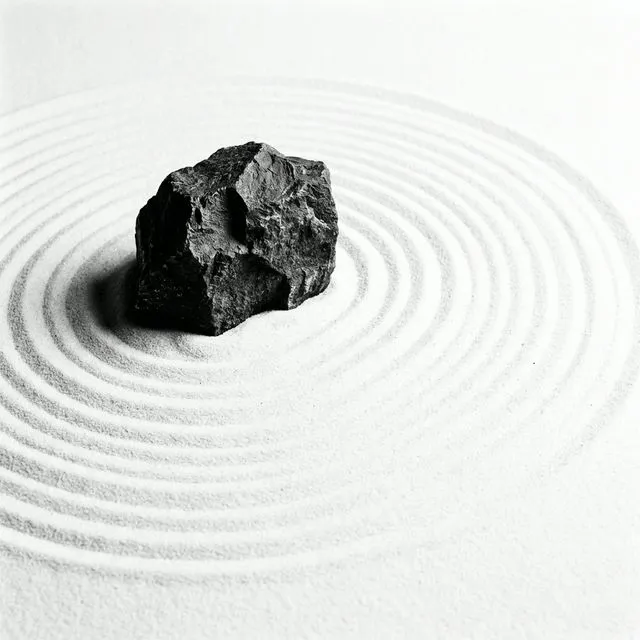
The Parking Lot Problem
I see this mistake in 9 out of 10 desktop Zen gardens and honestly, it makes me want to scream.
You buy the kit. It comes with three rocks, a bridge, a pagoda, a little moss tuft, and a rake. And because you paid thirty bucks for them, you feel obligated to use all of them.
So you cram them into that tiny 10-inch tray. The bridge leads to the pagoda, which sits next to the big rock, which is elbowing the moss.
That’s not “Zen.” That’s a parking lot.
Your eyes dart around, looking for a place to rest, but there’s nowhere to land. Instead of feeling calm, you feel a low-level buzz of anxiety. This is cognitive load manifesting on your desk.
What you are missing is the most critical ingredient in Japanese aesthetics. It’s the one thing you can’t buy on Amazon, but it’s the only thing that actually makes the garden work.
You are missing Ma.
What is Ma? (And No, It’s Not “Nothing”)
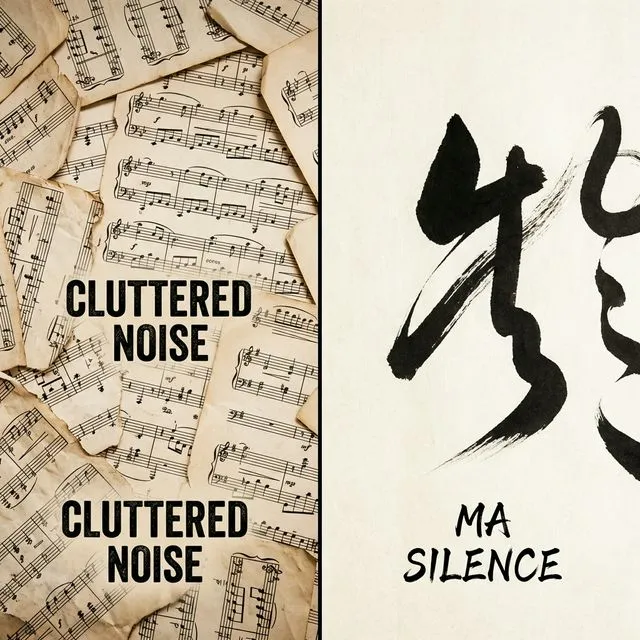
Ma (間) is usually translated as “gap,” “interval,” or “pause.”
But here in the West, we have a messy habit of thinking of space as “nothing.” We treat it like the empty background that needs to be filled with more stuff.
In Japanese design, Ma is not empty. It is full.
| Concept | Western View | Japanese (Ma) View |
|---|---|---|
| Empty Space | A void to be filled | An active ingredient |
| Silence | Lack of sound | The rhythm between sounds |
| Focus | On the object | On the relationship between objects |
| Goal | Decoration | Tension & Release |
Think of music. The silence between the notes is what creates the rhythm. Without the silence, it’s just noise (a concept central to the sonic sanctuary). Ma is that silence. In your minimalist garden, the sand isn’t just the floor; it is the negative space that gives the rocks (positive space) permission to exist.
The Ma Rule: “We shape clay into a pot, but it is the emptiness inside that holds whatever we want.” — Lao Tzu (Tao Te Ching, Ch. 11)
Look at the famous rock garden at Ryoan-ji in Kyoto. The fifteen stones aren’t the masterpiece. The masterpiece is the tension between them, held together by that vast, raked void of white gravel. This is Yohaku-no-bi—the beauty of empty space.
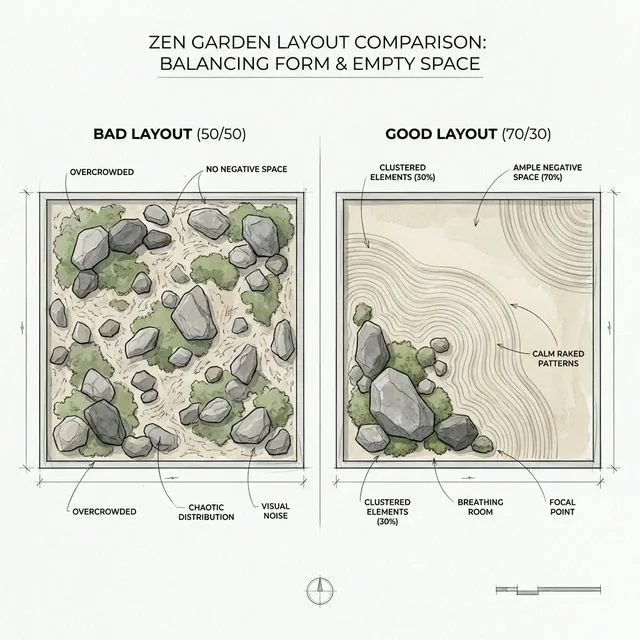
Zen Garden Layout Ratios: The 70/30 Rule
Okay, philosophy is great, but how do you actually do this without it looking like a cat litter box? You need a hard constraint. While ancient monks didn’t use percentages, modern designers use a helpful cheat code.
Adopt the 70/30 Guideline:
- 30% Positive Space: Rocks, moss, bridges, lanterns.
- 70% Negative Space (Ma): Raked sand, flat water, empty air.
If your tray is 12 inches wide, your “stuff” should occupy no more than 30% of the surface area. The rest must be left open.
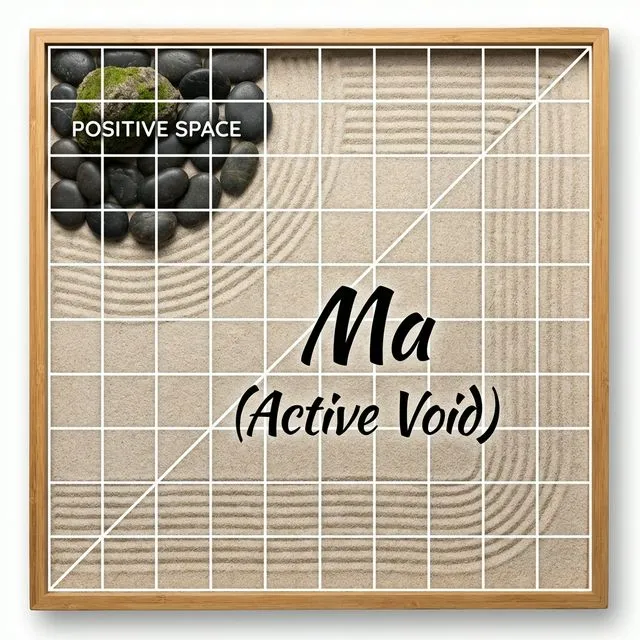
This feels wrong at first. You’ll want to center things. You’ll want to spread them out evenly like cookies on a baking sheet.
Don’t.
Grouping your objects tightly (clustering) creates a stronger sense of Ma than spreading them out. When you cluster your rocks, you create a massive, unbroken field of sand. That field is where your mind rests.
How to Rake for “Spatial Tension”
The sand in a Karesansui (dry landscape) isn’t passive dirt. It’s an active field of energy.
To make the negative space feel “alive,” you need to rake it with intention. This technique is called Samon (gravel patterns). And please, for the love of aesthetics, dig deep.
-
The Ripple (Mizu-mon)
- Action: Rake concentric circles around your rock cluster.
- Meaning: Implies the rocks are heavy—they are “dropping” into the water, sending ripples outward.
- Effect: Connects the positive object to the negative space physically.
-
The Current (Seigaiha)
- Action: Rake long, straight lines across the open 70% of the tray.
- Meaning: Suggests a flowing river or a vast ocean.
- Effect: Creates movement and direction.
-
The Tension
- Action: Ensure your lines are deep and parallel.
- Meaning: Sloppy, shallow lines look like dirt. Deep, crisp lines look like energy.
Pro Tip: The direction matters. Raking lengthwise makes the garden look faster and longer (like a river). Raking widthwise makes it look wider and calmer (like an ocean).
Secret Technique: If your lines look crumbly, lightly spritz the sand with water before raking. The moisture helps the sand hold those deep, architectural ridges.
The “Ma” Audit: Decluttering the Mind
Why does this matter?
Because your environment dictates your mental clarity. A cluttered desk equals a cluttered mind. A decluttered garden is a training ground for a decluttered brain.
This is the state of Mushin (no-mind)—a mental state free from anger, fear, or ego. You can’t reach Mushin if your eyes are constantly fighting visual junk.
Try this experiment:
- Take everything out of your Zen garden. Smooth the sand flat.
- Place one rock. Just one. Off-center.
- Stare at it for 60 seconds.
- Notice how the “empty” sand suddenly feels vast. It feels heavy. It feels important.
That feeling? That is Ma.
Shut Up and Subtract
Living in 2026 means navigating a flood of data. We don’t need more inputs. We need intervals.
Designing with Ma isn’t about being boring or lazy. It is an active choice to prioritize focus over fullness. By mastering negative space design, you aren’t just making your desk look like a design magazine; you are building a physical sanctuary for your mind to breathe.
Stop adding. Start subtracting. Let the “Ma” do the heavy lifting.