From Temple to Tabletop: A Brief History of the Dry Landscape
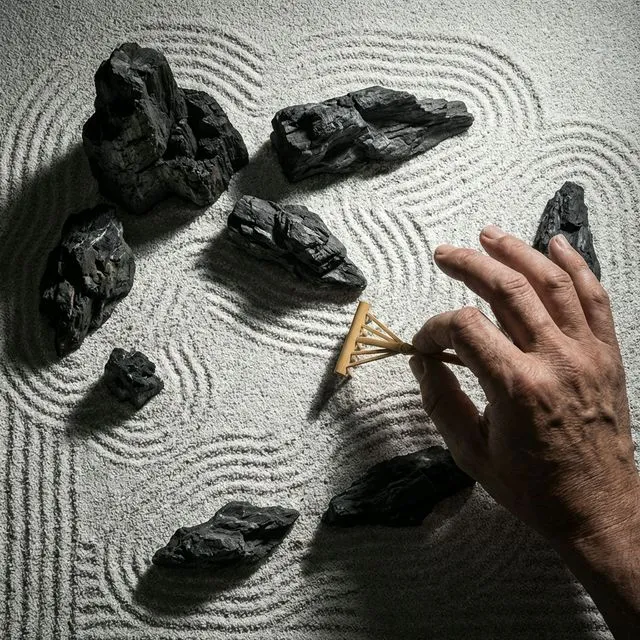
The truth is most of the “zen” products you see online are overpriced litter boxes. You know the ones. The flimsy plastic trays with neon pink sand and a resin meditating frog. Everyone buys them hoping for a quick hit of peace in a chaotic workday, only to let them gather dust.
Why do they fail? Because they strip away all the punishing, intellectual rigor of the real thing. If you want a tabletop sanctuary that actually grounds your fried nervous system, you need to understand the brutal origins—the actual tabletop zen garden history that gave birth to the karesansui.
The Myth of the Monks: The Shinto Bedrock
Don’t fall for the trap that Japanese rock gardens started with Zen monks staring at walls. They didn’t. The karesansui origins aren’t about chilling out; they’re about marking sacred territory. We have to go back to indigenous Shinto practices from the Heian period (794–1185).
- The Vibe: Shinto is all about designating sacred zones where the kami (spirits) reside. White gravel wasn’t decorative; it was a blaring alarm of spiritual purity.
- The Blueprint: If you want rulebooks, the 11th-century Sakuteiki is your bible. It’s the first manual that explicitly laid out how to build these dry setups. Let me tell you, working without water is a completely different beast—it demands absolute, unforgiving precision.
Pro Tip: Look, if you’re building a modern desktop setup, respect the roots. Use pure, untouched sand to emulate that original Shinto purity, not the craft-store glitter sand.
The Muromachi Shift (When It Got Brutal)
The real japanese dry garden history kicks into high gear during the Muromachi period (1336–1573). The Samurai were running the show, and they didn’t have time for strolling through pretty pleasure gardens or worshipping mythical islands. They demanded severe, brutal meditation tools. Zen Buddhism’s rigorous, no-nonsense discipline fit them like a glove.
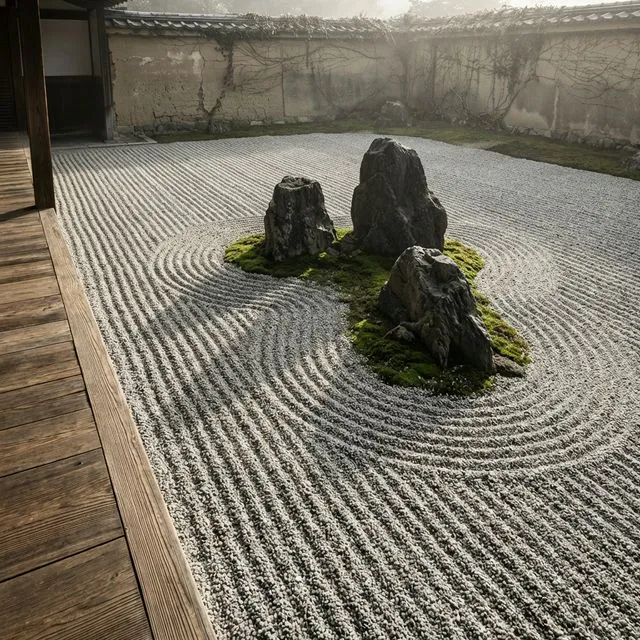 The Historical Temple Garden (Authenticity and Scale)
We transitioned away from literal myths to hardcore spiritual abstraction. I’ve stood in some of these Muromachi-era temples, and the silence is deafening. It’s just you, the rocks, and the crushing weight of the immutable universe. (If you want to understand the imperfection obsession of this era, check out our piece on The Art of Wabi-Sabi).
The Evolution: Before and After the Samurai
| Feature | Pre-Muromachi (Literal) | Muromachi & Beyond (The Zen Upgrade) |
|---|---|---|
| Why Build It? | Chasing immortality myths | Hardcore spiritual meditation |
| The Footprint | Massive estates you could get lost in | Contained, tense, petrified spaces |
| The Message | ”Look at my cool island.” | The crushing, immutable nature of the universe. |
The Mechanics of Stone and Sand
Let’s talk about dry landscape symbolism. Because it’s not random. Every single element is engineered to dissolve the boundary between you and the gravel.
By understanding this lexicon, you start to see why the plastic desk toy fails, and what an authentic zen garden requires.
- Embrace the Void: Yohaku-no-bi is the beauty of blank space. It’s the hardest thing for my junior designers to grasp. They always want to add more junk. Don’t. Stop adding. That empty sand isn’t missing something—it is the something.
- The Metaphorical Engine: That sand? It’s flowing water. Or it’s your unclouded mind.
- Space as a Tool: We break this down further in Mastering Ma: Negative Space in Zen Gardens. Read it if you want to stop suffocating your designs.
If you’re looking into zen buddhism garden history, you must respect the materials:
- The Bones: Stones represent the earth’s durability. You don’t just drop them on the surface like marbles; you bury them deep. Asymmetrical groupings, mostly triads. The precision is agonizing—if the angle of a “supporting” rock is off by two inches, the whole arrangement collapses visually.
- The Fluid: The gravel. You want the real stuff? You use shirakawa-suna sand. It’s a specific white granite from Kyoto. Its jagged texture holds deep raked grooves (samon) without collapsing. Smooth beach sand in a desk tray is a fool’s errand.
Ryōan-ji: The Final Boss
If we’re talking about the pinnacle, we have to talk about Ryōan-ji. Built in the late 15th century, it is purely abstract madness.
Measuring exactly 340 square meters. Fifteen stones. Five groupings. A sea of gravel.
The Trick: Here’s the kicker about the ryoan-ji garden meaning. From the abbot’s viewing deck, you can never see all 15 stones at once. One is always hidden. It’s a deliberate slap in the face to human arrogance. You literally cannot perceive the whole picture.
It refuses to be interpreted. It’s just an architectural mechanism forcing you to look inward.
Shrinking the Universe: The Desktop Sanctuary
So, knowing all of this grueling history and philosophy, how did we get from 15th-century Kyoto to your crowded home office? It’s simple. We just shrunk the universe down to a manageable scale without losing the discipline.
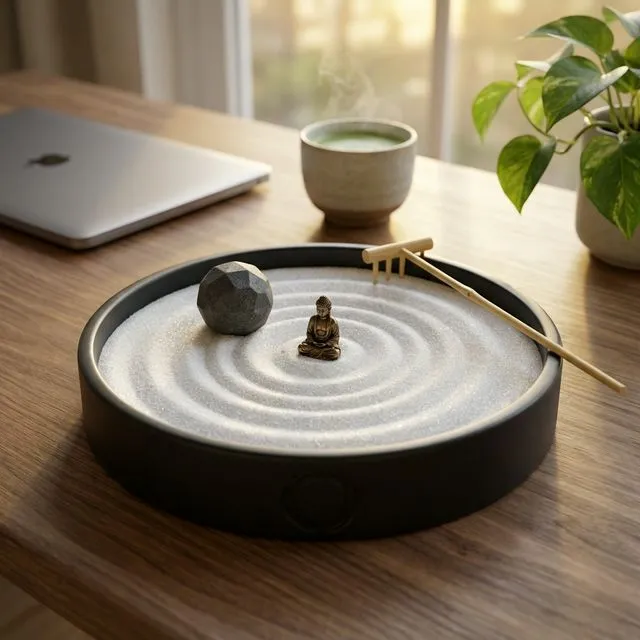 The Modern Tabletop Sanctuary (Intimacy and Wellness)
I am fiercely defensive of the tabletop garden. It’s not a toy. It’s a somatic grounding tool. We see these same tactile mechanics utilized in physical therapy and trauma recovery. When you drag that tiny bamboo rake through the sand—assuming you bought a good one, not cheap garbage—you are actively severing your panic spiral. (We talk about similar tactile grounding in our Botanical Bento and Shizen Zen Garden Upgrade posts).
You don’t need acres of Kyoto real estate to reset your nervous system. You don’t need the cheap gimmicks. You just need pure sand, heavy stone, and the painful willingness to realize the real mess isn’t on your desk—it’s in your head.
Before you open your inbox tomorrow and let the digital panic set in, take exactly three minutes. Rake one single, unbroken line in the sand. See what happens.