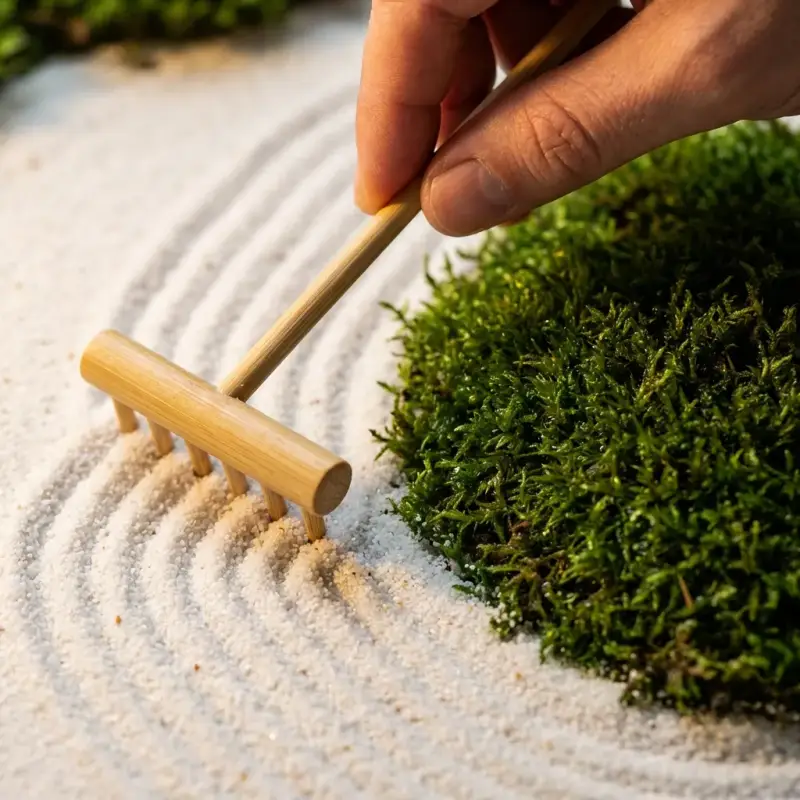
2026 Trend Alert: Designing a "Botanical Bento" Box for Your Desk
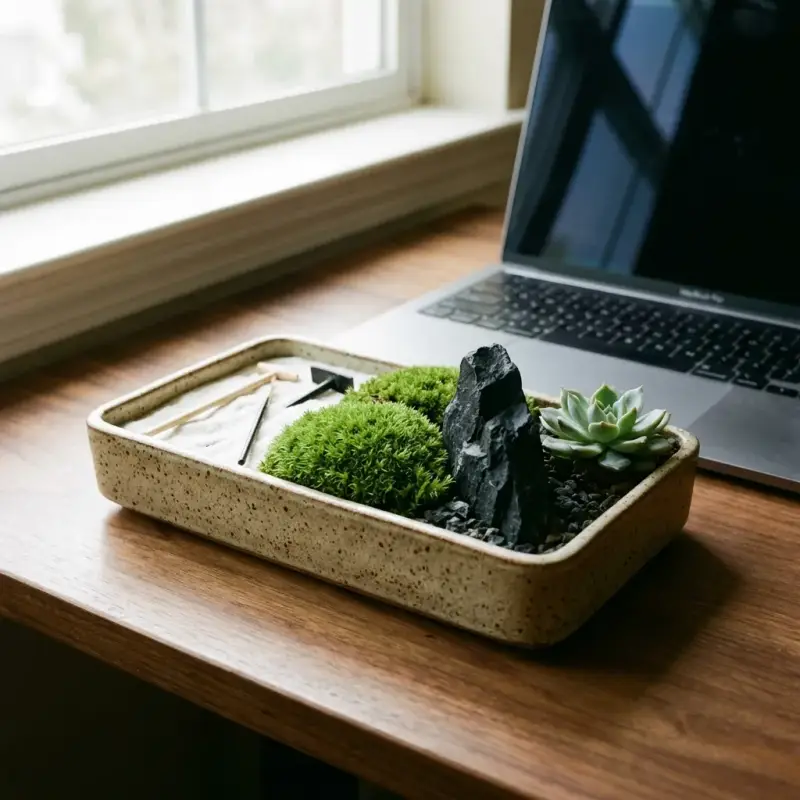
The Mixed Planter Is a Death Sentence
You bought the cute round pot with three plants crammed inside. The fern wants a swamp, the succulent wants a desert, and the moss just wants to be left alone. Two weeks later, everything is rotting.
Stop doing this to yourself.
The Botanical Bento Box Garden steals a concept dating to Japan’s Kamakura period (c. 1185 CE)—the bento—and applies it to your desk. Just as a bento box provides a balanced meal by separating flavors into compartments, a Botanical Bento separates your garden into distinct “ingredients.”
It is Small Space Garden Organization at its finest. Treat the garden as a collection of modular zones rather than a tangled mess, and you get three things:
- Visual Clarity: The grid layout is instantly calming to the brain (see: Neuro-Restorative Zen).
- Healthier Plants: High-water moss stays away from low-water succulents. No more compromises.
- Playability: It becomes a modular kit you can rearrange without repotting. Swap, don’t uproot.
Why Your Brain Loves a Grid
The “Botanical Bento” isn’t just an aesthetic trick—it’s a cognitive tool. We are collectively drowning in what we’ll call “Open World Fatigue,” a concentrated form of choice overload and decision fatigue 1 brought on by limitless options and unstructured digital environments. (Think of it as the mental equivalent of standing in front of a 200-item restaurant menu.)
When you look at a tangled, unstructured planter, your eye wanders aimlessly hunting for a pattern. But when you look at a grid? Your brain immediately understands the rules and exhales.
- Cognitive Load Reduction: The clear lines of the bento box act as “visual anchors.” Contained order in a chaotic world.
- The “Tetris Effect” for Wellness: Physically swapping out a dried-up plant for a fresh stone gives you a sense of agency and control. You aren’t “failing” at gardening—you are simply “updating your loadout.”
- Micro-Closure: Finishing the raking of just one small square provides a hit of dopamine—a moment of completion that powers you through the rest of your workday. Try it before your next meeting.
Step-by-Step Layout Guide: The Quadrant System
The most popular 2026 layout is the “Standard Quadrant.” You will need a shallow, rectangular planter (approx. 6” × 9” is ideal—the size of a real bento box).
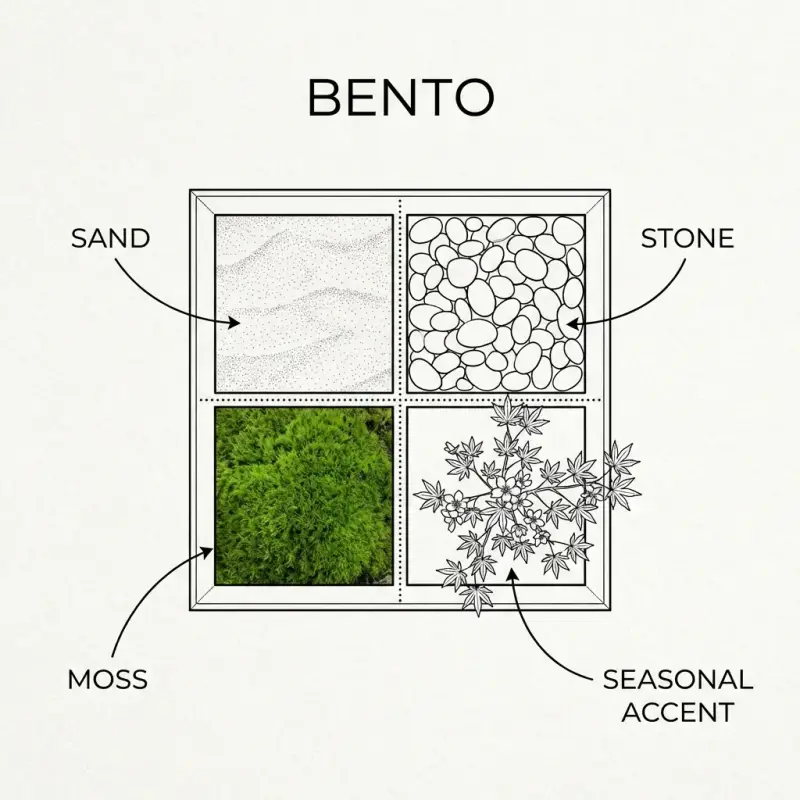
Visualize your planter divided into a 2×2 grid.
Zone 1: The Void (Negative Space)
- Element: Fine white sand or crushed granite.
- Function: This is your negative space—the “rice” of your bento that holds the meal together. Keep this quadrant completely empty except for your rake lines to honor the Zen principle of Ma (the space between things).
Zone 2: The Mountain (The Hero)
- Element: A single, dramatic stone (Ishi).
- Function: This is your focal point for height and stability. To honor the Zen principle of Fukinsei (Asymmetry), place it slightly off-center within its quadrant.
Zone 3: The Forest (The Texture)
- Element: Live moss or a dense ground cover.
- Function: This adds visual softness and acts as the “vegetable” side dish, embodying the Zen principle of Shizen (Naturalness).
Zone 4: The Season (The Garnish)
- Element: A rotational element (e.g., a pinecone in winter, a succulent in summer).
- Function: Connects your desk to the outside world, reflecting the Zen principle of Kanso (簡素, Simplicity).
Choosing Your “Ingredients”
A Modular Zen Garden fails if the ingredients fight each other. In a bento, you don’t put soup next to dry seaweed. Same rules here—don’t put ferns next to cacti.
The “Wet” Bento (The Forest Floor)
Best for: Low light offices, keen waterers.
- Sand: Black volcanic sand (holds moisture better).
- Stone: Seiryu Stone (Grey/Blue jagged rock).
- Plant: Cushion Moss (Leucobryum) or Fern Moss.
- Seasonal: A piece of driftwood or a fern frond.
The “Dry” Bento (The Desertscape)
Best for: Sunny window sills, forgetful waterers.
- Sand: Beige crushed limestone.
- Stone: Dragon Stone (Warm, cratered rock).
- Plant: Haworthia or ‘Living Stone’ (Lithops).
- Seasonal: A dried seed pod or a quartz crystal.
💡 The Partition Trick: In a true bento, dividers keep the sauce from touching the rice. In your planter, use thin slate shards or slightly buried plastic dividers to physically separate your wet zone (moss) from your dry zone (sand). This prevents the sand from wicking moisture away from the roots.
Advanced Bento Techniques: Beyond the Quadrant
Once you have mastered the 2×2 grid, give yourself permission to graduate to more complex “meals.”
The “Sashimi” Layout (Linear Flow)
Instead of a grid, use three long, vertical strips in a long, shallow tray (approx. 4” × 12”).
- Left: 1-inch strip of tall vertical moss like Haircap Moss (Polytrichum commune) as the backdrop.
- Center: 2-inch wide raked black sand river (The Flow).
- Right: A row of five small polished obsidian stones spaced exactly 1 inch apart (The Rhythm). This layout is ideal for narrow monitor risers where depth is limited.
The “Omakase” (Chef’s Choice)
This is for the confident designer. It involves breaking the grid with a “spillover” element using a larger 8” × 10” tray.
- Build your strict four quadrants (e.g., the “Wet” Bento ingredients).
- Then, place a 6-inch piece of Ghostwood that starts anchored under the Seiryu stone in Zone 2 and physically bridges over the sand in Zone 1 to rest lightly in Zone 4.
- This represents Datsuzoku (脱俗)—freedom from convention. In Zen aesthetics, rigid perfection is static; breaking the structure is what makes the design feel alive.
Maintenance of Separate Zones
The genius of the Botanical Bento is that maintenance is highly compartmentalized. You never have to worry about accidentally drowning a succulent while trying to save a fern.
1. The Sand Sweep (Daily) Use a miniature rake or a stiff paintbrush to reset the lines in Zone 1. This is your “transition ritual” before starting work—a signal to your brain that focus time has begun.
2. The Moss Mist (Daily for Wet Bento) Zone 3 needs humidity. Use a directed spray bottle to mist only the moss quadrant. The physical separation prevents you from accidentally watering the stone or the sand (which causes algae).
3. The Seasonal Swap (Monthly) Zone 4 is your seasonal rotating cast. Swapping out a pinecone for a river stone on the 1st of every month keeps the garden from becoming “invisible wallpaper.” It forces you to actually look at your desk again.
Troubleshooting Your Bento
Even in a controlled environment, chaos finds a way. Here is how to fix the most common “Lunchbox Disasters.”
Problem: The “Soupy” Bento (Overwatering)
- Symptoms: Your white sand is turning green (algae) or yellow (minerals).
- Cause: You are watering the plants, but the water is wicking sideways into the sand zone.
- Fix: Dig a “trench” between your moss and sand. Insert a physical barrier (a strip of plastic from a milk jug works perfectly and is invisible when buried). Replace the top layer of sand.
Problem: The “Stale” Bento (Boredom)
- Symptoms: You haven’t raked the sand in 3 weeks. It’s just a dust collector now.
- Cause: The design is too static.
- Fix: Change the “Hero Stone.” Go for a walk, find a new rock with a completely different texture, and swap it out. The change in weight and shadow will force you to interact with the sand again.
Problem: The “Cramped” Bento (Overcrowding)
- Symptoms: Your moss is growing over the edge; your succulent is touching the stone.
- Cause: Violation of Ma (Negative Space).
- Fix: Prune aggressively. In a bento, empty space is an ingredient, not an accident. If the zones are touching, you have lost the definition. Cut it back until you can see the soil line again.
Your Desk Is a Landscape
We are moving away from high-maintenance clutter toward intentional, modular design—and the “Botanical Bento” is the sharpest expression of that shift. Four quadrants. Four distinct purposes. One sanctuary that is as satisfying to organize as it is to behold.
So the question is: what goes in your first bento?